Showing posts with label captain marvel. Show all posts

Friday, May 9, 2014

Captain Marvel Masterworks Vol.1 review

There are some characters that just seem to haunt the fringes of your interest in comics until you finally decide to explore them in depth. While I’m not too keen on DC/Fawcett’s big red cheese, and I don’t find MF Enterprise’s “SPLIT!” version to be the campy masterpiece some praise it as, I’ve always seen Marvel’s ‘Space-Born Super-Hero” as the Captain Marvel, even though, as everyone points out, Marvel created him to secure copyright to the name. Granted, my fondness could stem from my first continuous exposure to the character being Jim Starlin’s acclaimed run and the good captain playing big roles in ‘important’ stories like the RoyThomasBrainFart Kree-Skrull War, or maybe it’s because, courtesy of a flea market, I ended up owning his first two appearances in Marvel Superheroes #12-13, as well as issue #4 of his own title where he fights Namor. Now, I fully admit I picked those books up because of the Golden Age reprints and because I go crazy for Gene Colan art and even crazier for Namor, but I always liked them because of the series’ gimmick, even though there were things in those stories that even as a teen I couldn’t suspend my disbelief about.
  Captain Marvel was about Mar-Vell; a member of an alien race called the Kree who came to Earth, took on a secret identity as a scientist and wound up becoming a superhero. On paper, it’s not too different a concept from lots of other alien heroes, going all the way back to Superman himself, and Cap’s costume wasn’t too markedly different from that of other spacemen like Adam Strange except for being in secondary colors.
 
  No, what made Mar-Vell unique was why he acted as a superhero. It wasn’t that he was raised by humans, or was an intergalactic policeman who decided to study our methods, or who fought crime since he was stuck here and believed evil should be eradicated no matter where it was, or because he was struck by the beauty of human life. Nothing like that. Mar-Vell was a soldier on a reconnaissance mission whose entire goal was to spy on us, and if need be, blow us all to kingdom come if we ever came anywhere close to developing weapons that could challenge the Kree empire.
 He only came off as a hero because his asshole superior officer, Colonel Yon Rogg, wanted to bang his girlfriend Una, so Yon-Rogg kept trying to force Mar-Vell into situations where he would be killed or forced to abort his mission (an offense punishable by death in Kree law), such as activating big homicidal robots to kill people who Mar-Vell was merely supposed to study, or tricking enemy alien races into attacking him. Mar-Vell would then fight these various menaces (mainly out of self-preservation and because he believed in sticking to the original plans to simply spy on Earth’s people, not kill them) and, to the unknowing populace of Earth, Mar-Vell would appear to be a benevolent superhero defending them.
 This could have been turned into a comedy series where the evil alien always ends up doing good by accident, or Invasion of the Body Snatchers-style horror; where the people of Earth have no idea that their champion is an alien spy. But the thing was, Mar-Vell was torn up inside because of this. He knew that, other than to Una, he was just another grunt to the Kree, while to the people of Earth who he was supposed to view as the enemy, he was appreciated and acclaimed as a hero, and noble soldier that he was, he couldn’t live with betraying trust, since he was a firm believer in showing honor even to his worst enemies. Even worse, he knew that eventually, he was either going to have to destroy us, or Yon-Rogg would find some way to make him look bad in the eyes of the Kree higher-ups and he’d have nowhere to go (if the Kree council didn’t kill him first).
 The final panel of #4, where Mar-Vell speeds off after battling Namor, the true hero of the story, and considers the tragic irony of his situation, always stuck with me for some reason.
 Many years later, I got a hold of the first Marvel Masterworks volume of CM, read up to the fourth issue (which I was already familiar with), and then, due to a bunch of factors, didn’t get a chance to finish reading and sort of forgot about it.
 
 That, however, has been rectified.
 
 And you know what? For a character created just to secure copyright, these stories are pretty damn good!
 
 Oh sure, there are plenty of ludicrous coincidences that even as a kid I found hard to swallow, namely, Mar-Vell conveniently happening across a dead rocket scientist named Walter Lawson who looks exactly like him and who he then impersonates to get access to Cape Canaveral.
 At the same time though, there are also some nicely realistic touches like a hotel clerk who becomes suspicious of Cap being a spy after noticing that ‘Lawson’ has no idea how to properly register, often uses false names and doesn’t handle money well (an interesting subplot that sadly gets hand waved a bit too easily), or people at the cape falling for the ruse, but admitting they detect something subtly “off” about ‘Lawson’, from the way he doesn’t understand various social norms or seems too forced in his slang, while others just write off his weirdness as harmless eccentricity, like a cab driver named Chester whom he befriends. There are also some nice moments of humor, such as Mar-Vell coming to appreciate mankind’s greatest achievement: The Coffee Break.
 

 The characterization of the supporting players is also quite good, and the situations created for them are handled uniquely. Carol Danvers, later to become a super heroine called Ms. Marvel (among several identities) is introduced here, and she’s as different from your typical female supporting character of the time as it’s possible to get. She’s a full-time working woman employed as the cape’s head of security, and although she needs to be rescued now and then, so does pretty much everyone else. Mar-Vell is the only one who knows how to stop the various alien threats that pop up, so having any human character defeat them on their own would come off as a stretch. And best of all, there is no romantic subplot….at first, but again, how it’s handled is quite unique. She doesn’t come to fall for ‘Lawson’, as she suspects him immediately and thinks he’s a spy (which he is, just not for the Russians), and there’s no attempt to portray her as secretly having feelings for him. In fact, next to Yon-Rogg, she becomes the biggest thorn in his side, with each time she appears building up tension. Using a female character in such an antagonistic light without making her a villain or a Lois Lane-type isn’t something you saw much in this era.
 However, Carol does end up falling for Captain Marvel. Again, this is handled in a far from typical manner. She’s just as suspicious of him initially as she is of ‘Lawson’, but because he saves her life several times, demonstrates his noble qualities and displays the grudging respect he has for her that he couldn’t show as Lawson, she gradually ends up falling for him over the course of many issues, without it ever coming off as forced.
 
 But here’s the thing; Mar-Vell does not at any time reciprocate her feelings or show any sign of falling for her (As Walter Lawson, he does occasionally make flirtatious remarks, but he’s clearly trying to keep her away from him by making her think he’s a sexist pig). He remains loyal to Una, and his attempts to protect Carol in particular are simply a combination of respect and because he’s afraid she might stumble onto something if he’s not around. However, Una sees them together and starts to worry that she might seduce him. Una could easily have been portrayed as jealous or unreasonable, possibly even ending up trying to kill Carol or betray Mar-Vell (remember all those times Lady Dorma would betray Namor or try to kill Sue Storm?), but instead, she’s portrayed with nothing other than sympathy. Her fears of losing Mar-Vell seem completely reasonable based on what she has to go on, and when she sees Cap kissing Carol (she forced herself on him and he immediately tries to pull away), it’s a legitimately heartbreaking moment.
 Una is also far from the typical weepy love interest (aside from a few lines about her feeling a ‘woman’s weakness”). She’s portrayed as a brilliant scientist and Mar-Vell’s go-to-gal for technology, and uses her expertise to get him out of several jams. She also gets one awesome moment where she knocks Yon-Rogg and his entire crew out with gas to buy Mar-Vell more time. It’s also made clear that she’s fully aware of Yon-Rogg’s lecherous designs on her, and even at her most paranoid about losing Mar-Vell, she’s smart enough to never trust Yon-Rogg or confide in him. In other Marvel series, she would probably end up falling for him in a fit of grief, or at least pretending to in order to make Cap jealous. Not here. There’s a lame subplot about how she and Mar-Vell are the only members of the Kree race that can feel emotion, but thankfully that isn’t dwelled upon much.
Yon-Rogg himself is easily the most despicable villain in late 60’s Marvel. He has no depth other than being a jealous, glory-hungry bastard, but you end up truly hating him on a level you don’t for say, Doctor Doom, because his evil is a real world, every day evil, and all of the drama in the stories come about from the emotional tension he creates, not because of his powers or latest super weapon. The way he mockingly tries to convince Una that Mar-Vell is cheating on her, or orders Cap to wipe out a city with a virus to prove his loyalty, or tries to get Cap in trouble with the Kree council really, really makes you despise him. A common reaction I’ve seen from people reading Silver Age Marvel is that the fights with supervillains often seem like distractions from the real drama that takes place out of costume, and that you often want to see supporting characters or ‘employers” like J. Jonah Jameson, Senator Byrd or General Ross pummeled more than the actual villains. Since Yon-Rogg is both villain and supporting character/employer, he comes off as far more compelling.
 Roy Thomas writes the first four issues and the second appearance, and he does a fine job. His purple prose is perfect for the space opera/soap opera going on, and he gets in several great lines which really capture Mar-Vell’s loneliness and inner conflict. He does however, have a tendency to reuse familiar characters as antagonists too much (something he admits to in the introduction). First we have the Sentry, The Super Skrull and Namor (all Fantastic Four-related characters). Things pick up when legendary DC oddball, Arnold Drake, takes the reins. He comes up with some interesting foes like a Soviet monster called the Metazoid, a living solar flare called Solam, alien pirates and a robot created by the real Walter Lawson (who it appears was far from saintly, or sane). Drake does reuse familiar Marvel villain Quasimodo the living computer, but gives him the bizarre gimmick of seeing himself as the ‘liberator’ of machines. Seeing him talk about the oppression of his “brethren” (drills, heaters and power tools) is just the kind of looniness you’d expect from Drake’s Metal Men and Doom Patrol, and makes him a lot more interesting than the rather vaguely defined villain from the Fantastic Four annuals.
  The Metazoid story is the one that most impresses. The Metazoid is portrayed as a tragic figure, an ordinary man arrested by the KGB and put on trial for speaking out against the USSR, then mutated into a monster and sent to abduct Lawson to prove his loyalty; if he fails, he will never be made human again. The Metazoid’s plight provides a fascinating counterpoint to Mar-Vell’s conflict with Yon-Rogg and his turmoil over whether to prove his loyalty to the Kree or to do the right thing. The fact that neither Cap or the Metazoid ever realizes the similar situation they are both in is a nicely mature little touch. It doesn’t end happily, and succeeds in creating a genuine feeling of ambivalence in the reader. It’s so good, you can easily forgive the Metazoid’s vaguely defined powers and appearance (is he made of rock, fur or tar?).
 The artwork is excellent throughout. Who knew Gene Colan “comic's prince of darkness” (as Wizbang called him) could be so good at space opera? Much maligned inkers Paul Reinman and Vince Colletta also do a fine job. This Masterworks edition features photocopies of Colan’s pencils before they were inked, and although they do look more impressive prior to inking, that was pretty much the case with every Colan inker. Reinman’s scratchy style gives things a rough-hewn, gritty mood, and although I’ve heard that Colan hated Colletta so much he sometimes went back and re-inked his own work, all I can say is that either he found time to do it for every issue here, or Colletta’s reputation for erasing is exaggerated. This stuff is fantastic.
 Don Heck takes over with the fifth issue (also the same issue where Drake arrives) and seems much more comfortable on this strip than with The Avengers, which is where most of Heck’s poor reception comes from. Heck was a fine artist, just admittedly not a superhero artist, more suited to science fiction and romance (You could always tell he enjoyed drawing Tony Stark more than Iron Man), so he’s at home here. Like I said before, some of his character designs are kind of odd, but then again, what is a ‘Metazoid” supposed to look like anyway? This is some of his best work.

 I really, really enjoyed this volume. Some people really hate this series, calling it a cynical copyright grab, or “a foray into sustained tedium”, often by pointing out the radical changes the premise would undergo (Mar-Vell eventually ended up becoming a space wanderer, an approximation of the old Billy Batson/Shazam concept, then a cosmic philosopher) as proof that he was a “nothing” character without a unifying concept. It may indeed be true that those abrupt changes destroyed the series (I haven’t read many of them and can’t comment), but I have to say, there’s nothing wrong with the original premise presented in these stories at all. It’s one of the most compelling (and grim) ideas for a ‘space hero’ series I’ve seen, and as long as it lasts, I think I’ll enjoy reading more of these collections before getting to the Starlin stuff. There’s nothing to be ashamed of here at all. 4/5.


Saturday, August 31, 2013

Shazam! The Greatest Stories Ever Told review:


 Never let it be said that I’m not consistent. For my 100th post, I decided I would hurt the one I love, and reviewed the lackluster first volume of my favorite series; The Spirit. So it seems fitting that I’m about to follow it up by reviewing a “greatest collection” featuring a character and series that longtime readers know has been my personal whipping boy since as early as my second post: Captain Marvel, or Shazam, as DC is calling him these days for legal purposes. How does that fit in with me criticizing my favorite series?
  Because I gotta say, for a collection of supposed high points for a character I don’t particularly like; it’s a nice read.

 Now don’t get the wrong idea, I haven’t completely changed my opinions about the series; I still find the Golden Age stories overrated and the fans hypocritical (Although more of them are coming out and admitting that they only follow Shazam comics because of Black Adam, who has rapidly been gaining a Wolverine/Punisher level of idiotic fans ever since Infinite Crisis where he gouged out Psycho Pirate’s eyes), and this shares many of the same faults that mar DC’s other “Greatest Stories” volumes, but that’s not necessarily the character’s fault. I can also say, after reading pretty much every Marvel Family story available on sites like the Digital Comics Museum, I wouldn’t really consider many of these “great” stories either, but all things considered, this book has some decent stuff in it.
-Introducing Captain Marvel from Whiz Comics #2 (1940): This is the origin story, with newsboy Billy Batson being led by a mysterious figure down to Shazam’s lair and being given his power, then getting a job as a radio announcer from radio station president Sterling Morris (Who is realistically skeptical of just what a kid Billy’s age could accomplish). It’s a fun wish-fulfillment adventure, although personally I find the non-superhero fantasy elements of the story more appealing, like Shazam’s bizarre subway train and the hall showing the statues of the Seven Deadly Sins.
This story also introduces the evil Dr. Sivana, who of course becomes Captain Marvel’s archenemy (and the most overused villain of the Golden Age with the exception of Adolf Hitler). What’s most interesting about Sivana is that his plan, to extort money from the government or else he’ll disrupt radio signals so people can’t communicate, is actually fairly plausible and not too science fiction-y (It’s not like he’s threatening to conquer the world, or anything). If this story were retold today, he’d probably do the same thing, except with the internet.
 All in all, it’s fun, and hard to really complain about. You have to admire a story which sets up the hero’s origin and career, as well as introduces his employer and archenemy all in one story. C.C. Beck’s uncluttered art is appealingly childlike, but has a determined looking grimness to it at the same time. 4/5.

 -Untitled story from Captain Marvel Adventures #1 (1941):
  Billy hears a signal from some far-off alien people who have been enslaved by reptilian creatures called the Dragon Men. He travels to their planet and ends up caught up in a battle with them, and meets a scientist, his lovely daughter, a traitor and the Jabba the Hutt-like king of the Dragon Men.
 Man, I wish more CM stories were like this! This one has far more of a Timely feel to it, probably because of the lettering by Howard Ferguson and the art by Simon & Kirby. Being drawn by Kirby is probably the only reason this particular story was reprinted, but when it’s this much fun I can’t complain. Interestingly enough, Captain Marvel is referred to several times as “The Thunder God” in this story. Fun stuff. 5/5.

-The Trio of Terror from Marvel Family #21 (1948): Three owners of a failing carnival steal a book of magic from the Marvel family and end up accidentally summoning three mythological creatures by saying “Ziggoz Zarilly Goosh”. The creatures are a Satyr, the Hydra and an Aargus.

  Here’s C.C. Beck’s idea of what a Hydra looks like:

  This is what the Hydra looks like according to Greek mythology:
Almost didn't recognize you there, pal

 Man, that’s the kind of underwhelming character design only Bernard Baily could pull off. The story itself really isn’t much fun either, and the three carnival owners end up going unpunished.

 Also, “Ziggoz Zarilly Goosh” has got to be the worst magical spell I’ve ever seen in a comic book. Say what you will about Stan Lee, but at least the spells he came up with in Doctor Strange sounded cool. 2/5.

-King Kull and the Seven Sins from Captain Marvel Adventures #137 (1952): No, this isn’t a Disney rip-off from Goodtimes. In this story, a bunch of people start being dicks for no reason, and it turns out that the reason why is because King Kull (A caveman in a horned helmet who was set up to be Cap’s new archenemy in the 50’s) has brought Shazam’s statues of the Seven Deadly Sins to life, who go around tossing “sin bombs”. A fairly amusing idea a lot of humor could have been wrung out of, but instead it turns into a simple fisticuffs story when it could have been more whimsical (This is supposedly the most whimsical comic book series of all time and better than anything Eisner or Cole ever did *rolls eyes*). A waste of a good idea, because like I’ve said, I find the way that the Sins are drawn amusing and the whole “sin bomb” idea is very surreal. 2.9/10.
-Captain Marvel battles the World from Captain Marvel Adventures #148 (1953): The Earth gets fed up with people drilling holes in it for oil, so it decides to make life miserable for humans by causing weather changes and other catastrophes, all of which Captain Marvel foils without ever thinking of them as anything but natural disasters.

 Now THIS is the kind of Captain Marvel story that lives up to the hype the fans give the series, and would you believe it? It’s not famous or revered at all! But it’s still a fantastically weird, whimsical story. How could you hate something where Earth itself is the villain? It’s like all of those shitty “Nature’s revenge” movies, the difference is that not only is it actually good, it also doesn’t try and ram an environmental message down our throat. Quite the opposite, here it’s nature which has to learn to be tolerant of us! There are just no words for how awesome that is, and in today’s world of shitty environmentalist propaganda, this story is still relevant.

  Easily the best story in this book, and the best drawn of the ones done by Beck. 5/5.

 -The Primate Plot from Marvel Family #85 (1953): Several apes are seen running around the city, presumably escapees from a zoo, but instead they turn out to be diplomats from a jungle city of intelligent apes, representing King Zonga. Zonga apparently just wants access to human technology so he can increase the quality of life for his people, and the Marvels, as well as the rest of the world, eagerly helps out. However, they quickly notice that something’s amiss…
 This one had a plot twist I didn’t see coming, in fact, it might be the most original take on the old “civilization of talking animals” trope I’ve seen in a while, although it does owe a bit to The Island of Dr. Moreau. Most such stories are used just to make some heavy-handed metaphor about racism or about how humans suck, and are usually written by wannabe satirists who have read the Hounhyms chapter in Gulliver’s Travels but lack Swift’s talent. This one doesn’t try any of that shit, but instead just uses the concept for a wonderfully batshit sci-fi adventure. 4/5.
-In the Beginning/The World’s Wickedest Plan from Shazam! #1 (1973): Shortly after DC acquired the rights, they published this issue, so while it’s important in a significant sense, all it is really is a primer on who Captain Marvel is for new readers. Unrateable, really.

-Make Way for Captain Thunder! from Superman #276 (1974): This is one of the oddest stories in the volume, and technically it isn’t a Captain Marvel story at all, but it’s entertaining for those same reasons. A newsboy named Willie Fawcett wanders the streets of Metropolis, not knowing how he got there. As Superman soon discovers, Willie is from another dimension and is the alter ego of a superhero named Captain Thunder, the problem though, is that Captain Thunder is under a curse which turns him evil, but Willie doesn’t know that and instinctively transforms into Captain Thunder whenever danger is present.
  As you can tell from that plot synopsis, the character of Captain Thunder/Willie Fawcett is a pastiche of Captain Marvel/Billy Batson. Presumably this story was written before DC acquired the rights proper to the real Captain Marvel, but published afterward. Still, it’s fun seeing all of the elements of the character that were altered to distance him from the real character, like having the Shazam figure be a Native American shaman, or the Monster Society of Evil being made up of Universal Monsters:
 One also has to wonder if this was an influence on the depiction of the evil Kid Miracleman/Johnny Bates in Alan Moore’s Miracleman run. Weird story, but I’m glad they included it. 3.9/5.

-The Evil Return of the Monster Society from Shazam!#14 (1974): This story is another odd choice for an inclusion, because the entire reason it’s notable is because it features, well, the return of the Monster Society of Evil. You know those really long, shitty, overblown ‘events’ that Marvel and DC have been doing regularly since the 80’s? Well, the first one was done by Fawcett in it’s Captain Marvel titles back in 1943, involving a team up of a bunch of villains into a ‘society’ that Captain Marvel fans have declared the first supervillain team in comics (It wasn’t). The whole thing was reprinted in a huge hardcover in the 70’s, and honestly, is pretty lousy. Thus, it seems odd that this story would be chosen since none of the original Monster Society stories were reprinted or even mentioned here (except for the ‘Monster League’ parody that appeared in the Captain Thunder story). If you weren’t a comics fan and had never heard of the society, you’d be pretty baffled as to why this was included.

 That said, it’s a pretty amusing little story, mainly because of the interactions of the villains during down-time. The scene where the hulking brute named Ibac hits on Sivana’s homely daughter (Who looks like, and was later retconned to be, a clone of Sivana) is pretty funny.
Believe it or not, I know a guy who used that as a pick up line
3/5.

-With One Magic Word from DC Comics Presents Annual #3 (1984): Now we’re talking! Roy Thomas plotted this story, while Gil Kane drew it, and the result shows off both men’s talents to the max. Dr. Sivana comes up with a brilliant way of defeating Captain Marvel; since the letters in the word Shazam stand for the names of various mythological heroes and deities and their attributes (The speed of Mercury, the wisdom of Solomon, etc), Sivana alters the rock of eternity so that Captain Marvel takes on the negative qualities of those heroes and thus susceptible to defeat. He then steals the powers of Shazam for himself, and Superman must stop him.
 This is a great example of playing with the mythology behind a character without resorting to parody, and it still makes for a perfectly good action story at the same time (And you can’t fault Gil Kane when it comes to action). I mean, it makes sense, if you want to defeat a superhero who gains his powers from a source, and you can’t destroy the source, why not change it so it affects him negatively? Admittedly not much is done with the idea of Captain Marvel taking on the negative qualities of the Gods (He mostly just gets cocky and gets trapped under rocks), but it still works. There are also some amusing moments of Sivana, having turned himself into a being similar to Captain Marvel, continually renaming himself with a different military rank (Major Sivana, Colonel Sivana and onward). Easily the second best story in the book. 5/5.
-Where Dreams End from L.E.G.I.O.N ’91 #31 (1991): Captain Marvel accidentally winds up in an alien bar and runs afoul of Lobo (Lobo, for those who don’t know, is DC’s  ridiculously over-the-top parody of characters like Wolverine, who stopped being a parody of such characters and became the poster boy for them). This story is played for laughs, but the main joke; the contrast between the sleazy Lobo and the good-natured Captain Marvel, wears thin quickly. I think this story may have been trying to make a point about feuding generations of comics fans, but I’m not sure. Very choppy and hard to follow at times. 3/5.

  -Yeah--This is a face only a Mother could love…from Power of Shazam #33 (1997): Captain Marvel meets up with a young fan of his who was horribly disfigured in a fire caused by a supervillain named the Arson Fiend. Captain Marvel then begins searching for a way to help the boy restore his face.
This is a rather sweet-natured story for one that begins with a shock moment (Full page shot of the boy’s ravaged face saying “Yeah-this is a face only a mother could love…though even she can be frightened by it if I catch her off guard”). This features lots of cameos by regular villains and supporting characters from the short-lived Power of Shazam series from the 90’s. Some of these characters had appeared in the Golden Age, but only became really prominent in this series, thus, you kinda feel like you stumbled into a long-running series that isn’t really new-reader friendly. But you know what? It actually makes me interested to read more of it.

  While I have to admit this story did cause a few “awwww” moments from me (particularly the ending), I also can’t help but feel it’s kinda shameless and manipulative, like a “Very Special Episode” of some lame sitcom trying to be relevant. For example, the creator credits aren’t listed until the end of the story, as if to say “Hey! Did you like this one? Well, here are our names so you can be sure to remember them when time for the Eisner awards roll around!”. Also, if that burned kid never appeared in any stories after this (I can’t find any info online) and was only used for this story, then shit I was right. Still, it’s a lot less tawdry than most such stories are, and maybe it’s a good thing the kid never came back; later writers might have turned him into a vengeful supervillain or something. 3.9/10.

  -Out of the Dark Cloud from Adventures in the DC Universe #15 (1998): Billy finds himself transforming in strange new ways each time he says Shazam, and starts trying to find the reason why. Could the very deities he calls upon have something to do with it?

  Another story which has fun with the deities that form the “Shazam” name. It’s mostly for fun, and works quite well. At first I thought this story was from Jeff Smith’s recent All Ages Captain Marvel series, since he wrote the intro to this volume, but it’s actually from a short-lived series featuring “animated’ versions of DC characters featuring Bruce Timm-style artwork. 3.5/5.

 Well, well. Count me surprised. While I can’t say that this volume made me a fan of Captain Marvel, it does contain some enjoyable stories. I’ve come to the conclusion that the appeal of the character for modern readers lies less in what his stories were actually like, so much as that he and his stories represent what some fans tend to wish comics were like when complaining about how dark modern comics are, just like how some folks romanticize the 50’s as a simpler time even though it really wasn’t. Basically, what I’m trying to say is that Captain Marvel has sort of a built-in nostalgia factor for people who’ve never read the original stories, thus, this feeling of innocent, wistful adventure brings out a kind of sentimentality in modern writers when they tackle the character or create tributes to him, and it creates a similar feeling in those who read such stories. Captain Marvel was the best-selling character of the 40’s, thus, regardless of quality, he became the poster child for “innocence” in comics.
  You do have to wonder though if future generations are going to feel somewhat similar towards Rob Liefeld and Image-style comics though, after all, they were also the best-selling comics of their time.

 Also, I’m going to give props to DC for not reprinting any Black Adam stories to hook the fanboys with (Actually, prior to the 90’s, there were hardly any stories featuring that character). They also deserve credit for not playing up Jack Kirby’s story, or including samplings of Jeff Smith’s recent series. These “Greatest Stories” usually do things like that (Featuring first appearances of popular villains regardless of quality, hyping up a story worked on by a famous creator even though it was his only work on the character, or pushing a new series) and stick out like a sore thumb. This volume is refreshingly free of that.
  So yeah, considering how terrible “Greatest Stories” volumes can be, and my reticence about the character, I’m going to admit….I liked it. 4/5.

Sunday, May 13, 2012

The First Supervillain Team: A Comic Book Mystery solved!

  A short while ago, I was trying to sell my Monster Society of Evil hardcover from 1989, so I went online to see if it was true that the book had had a limited print run. I found out what I needed to and sold the book, but I found out an obscure fact on Wikipedia’s page about the Monster Society of Evil. Apparently they were:

 The footnote linked to a book called 500 Comic Book Villains by Mike Conroy, which I’ve seen in several comic shops. As anyone who reads this blog knows, I hate Captain Marvel and anything related to him with a passion (the reason I owned that MSOE hardcover was because a friend of mine gave it to me as a joke/present after he found it at a flea market for five bucks) and have seen a lot of things falsely attributed to the Big Red Cheese’s titles, but this was the first time I’d heard this particular claim.

 Oh, I’d heard some historians who were fans of Captain Marvel call the JSA’s Injustice Society and Wonder Woman’s Villainy Inc. rip-offs of the Monster Society, and while I wouldn’t call them rip-offs per se, the timeline and the fact that the Captain Marvel titles were the industry’s best-selling books during the era does support the idea of the MSOE being the first. The Injustice Society debuted in October/November of 1947, while Villainy Inc. debuted in 1948. The Monster Society of Evil debuted in 1943.
 It seemed like a clear cut case.
 But what did it really prove?
 All it proved was that the Monster Society predated the Injustice Society and Villainy Inc. It didn’t prove that they were the first supervillain team. Given the “tell don’t show” mentality of a lot of Golden Age comics, there probably is a lot of truth to the statement that previous supervillain teams were made up of one-shot villains who had never previously appeared. Nevertheless, the criteria establishes that the villains had to have appeared previously for a group to count, and I could think of several supervillain team-ups that predated the Monster Society and fit that description.
 Off the top of my head, I knew that the first time two villains appeared in the same story was in Batman #2, the villains in question being none other than Joker and Catwoman, both of whom had debuted in the previous issue. This issue was published on June 1st, 1940 as the Summer issue (Batman’s own solo title was a quarterly then). However, it doesn’t really count, since not only does Catwoman play a heroic role in the storyline, but the Joker spends most of the story unconscious. It’s certainly the first time two villains met, but can’t really be considered a “team-up” at all, despite several websites erroneously saying so.
 Much later of course, in Batman #25, the Joker would team up with the Penguin. That issue however, came out in 1944.
 The first time two established villains actually joined forces was in More Fun Comics #70 dated August 1st 1941. Here, Doctor Fate’s foes Wotan (who had appeared in More Fun #55-56) and Ian Karkull (who had debuted in the previous issue) created a “city” in the arctic.
 Interestingly enough, both of the two villains seemed to get along fine, something most supervillains are notorious for not doing.
 Later, in September 1942; Captain America’s foes The Black Talon and The Black Toad teamed up in the story “Tomb of Horror” from Captain America Comics #18 (which I actually recall being posted online a few years ago but can’t find for the life of me). Black Talon had previously appeared in Captain America Comics #9 and Young Allies #2. Black Toad had appeared in Captain America Comics #7, and still remains mildly infamous due to the fact that he looked nothing like a toad whatsoever. Unfortunately, the whole story turned out to be a dream.

 That same year, Frankenstein’s Monster, who had his own series in Prize Comics drawn by Dick Briefer, teamed up with The Black Owl’s enemy Doctor Devil, who had appeared previously in Prize Comics #15.
 This was the first time villains from two different series (albeit in the same anthology book) would team up. This happened in Prize Comics #22.
No comment

 1942 was a record year for villain team-ups. In Hangman Comics #3, villains Captain Swastika (who had debuted in the previous issue) and The Executioner (who debuted in issue #3 but in a separate story, it was an anthology book) also teamed up. This was notable as the first time two villains who had teamed up turned against one another.
 All of these stories predate the Monster Society.
 “But wait!” cry the Captain Marvel fans. “Those stories don’t count either because they only involve two villains, hardly qualifying as a group!”
 Perhaps so. However, going by those rules, there was still one supervillain group consisting of several (going by the definition of several as more than two) previously established adversaries that predated the Monster Society. Ladies and gentlemen, I give you the story of comicdom’s first true supervillain group.
 It began with a broken man.
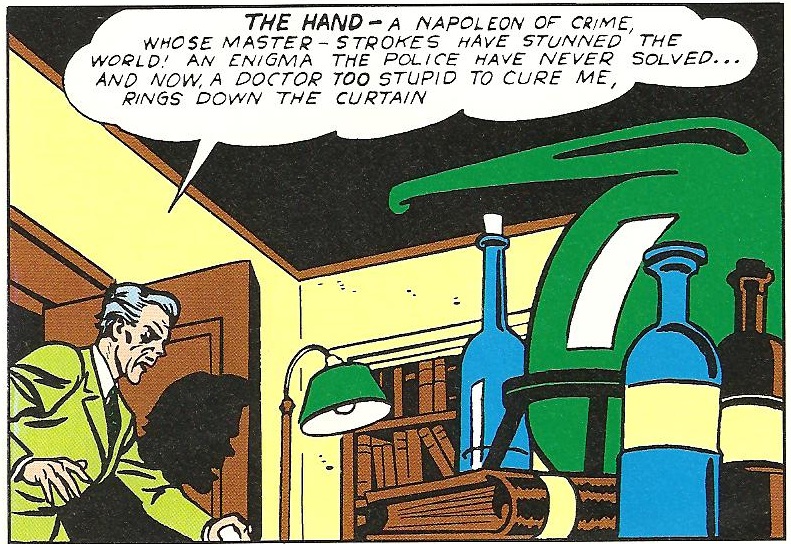
 Arch-criminal The Hand (who resembled the unholy love-child of Boris Karloff and Terry Thomas) found out that he was terminally ill:

 Wanting to go out with a blaze of glory, The Hand gathered several of the nation’s most dangerous criminals:
 The Red Dragon,
 The Needle,
 Professor Merlin,
 and The Dummy.
 However, like all good supervillains, The Hand felt it just wouldn’t be as fun without challenging some super heroes to thwart his crimes. He put an ad in the paper contacting The Green Arrow and Speedy, Star-Spangled Kid and Stripesy, The Vigilante, The Shining Knight and The Crimson Avenger.
 Yes folks, this was the story which introduced the Seven Soldiers of Victory to the world, although they weren’t called that yet. The comic was Leading Comics #1. The issue was released on December 1st 1941 as the “Winter” issue.
 ‘But wait!” cry the fanboys again. “The Hand was a completely original character who had never appeared before! He doesn’t count, and clearly he is the most important part of the group!” True. But the same could be said of Mister Mind, who also had never appeared before the Monster Society of Evil was formed, and who also was clearly the most important member of the group, in fact, the big overriding plot element of the whole arc was the mystery over what Mr. Mind was.
 “So who cares!” shout the fanboys “None of the other villains in the Hand’s gang were previously established foes either! I’ve read a million Golden Age comics, and I’ve never heard of any of these bozos”.
 Well, it just so happens that the members of The Hand’s gang had indeed appeared prior to this story. Just because they’ve all fallen into obscurity doesn’t mean they never existed. Also, if you've never heard of the Dummy, then clearly you aren't as familiar with Golden Age villains as you think you are.
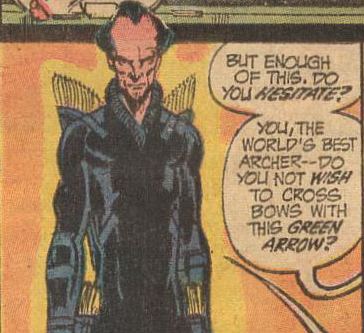
 Professor Merlin had previously appeared in More Fun Comics #75, in the third Green Arrow story.
 Arguably the first supervillain that the Emerald Archer ever encountered, I’m genuinely surprised that the not-so-good professor has fallen into obscurity, considering that both in name and physical appearance, he resembles the later villain Merlyn the Dark Archer (whom DC has been trying to push as being Green Arrow’s archenemy in one of the biggest failings at 'show don’t tell' in comics history).
 The Needle, whose gimmick was that he was so skinny he could slink in and out of places, had previously appeared in Star-Spangled Comics #4 and #7 and after this story, would continue to be a recurring foe of the Star-Spangled Kid and Stripesy.
 Interestingly enough, the Needle was not SSK’s most prominent foe. That honor would go to a fellow named Doctor Weerd.

............

 Star-Spangled Kid didn’t have much luck when it came to rogues.
 Most interesting of the villains was Shining Knight’s adversary The Red Dragon, who had previously appeared in Adventure Comics #69. Born deformed, he hid his face behind a red mask but wore a tuxedo and top hat. A pretty striking look for a villain, you must admit. At the same time, he was also extremely incorrigible, manipulating a group of Native Americans and indiscriminately killing them when they no longer served a purpose. One has to wonder if he was an inspiration for Thomas Harris’s character Francis Dolarhyde, who was also born deformed, and referred to his split personality as “The Red Dragon”.
 The most famous villain in The Hand’s gang was The Dummy, a ventriloquist’s dummy whom it was unclear as to whether he was an ordinary dummy used by a cunning criminal, or somehow alive. He was almost certainly the inspiration for the later Batman villain Scarface, who has also been portrayed as ambiguously supernatural. Folks, I’ve had a lifelong fear of ventriloquist’s dummies, and let me tell you, if I’d read this comic as a kid, I’d probably have crapped myself. As for all the other great, creepy Golden Age villains? Iron Jaw, Red Skull, Solomon Grundy, Two-Face and The Claw probably have nightmares about this character.
Wanna know what just disappeared after looking at this? Your soul.

 However, effectively scary as he may have been, The Dummy wasn’t a previous foe of any of the heroes. That said, he soon would be, becoming Vigilante’s personal archenemy and making several appearances in Vigilante’s strip in Action Comics. He even returned in Leading Comics #8. He’s one of the most well-known secondary villains of the Golden Age.
 There was also a villain in the gang named Big Caesar, who, to my knowledge, had never appeared anywhere prior to this story, and never did afterwards. I can see why, as he was just an ordinary thug.
 Still, The Hand’s gang was the first team of villains in comic books to feature several established adversaries (and would spawn a major villain for one of it’s heroes), and predates the Monster Society by two years. I’d say that it’s cut and dry that these folks count as the first true supervillain group.
 Only problem? They didn’t have a name for their organization.
 Not that something as simple as that should disqualify them, but if one insists on a villain group only counting if they have a name, then there was also The Revenge Syndicate, who appeared in Bulletman #7.
 This group was made up of recurring Bulletman villains The Weeper (who recently appeared on Batman: The Brave and the Bold), Black Rat and Murder Prophet. Bulletman #7 hit the stands in 1942, a full year before the Monster Society.
 So, even if you disagree as to whether the Hand’s gang from Leading Comics #1 or the Revenge Syndicate should count, I hope that this post has made it clear that the Monster Society was not the first supervillain group in comics. Not by a long shot.

 By the way, check out this creepy coincidence on the DC Wiki where I swiped borrowed the image of Professor Merlin from: