Showing posts with label Silver Age. Show all posts

Tuesday, October 21, 2014

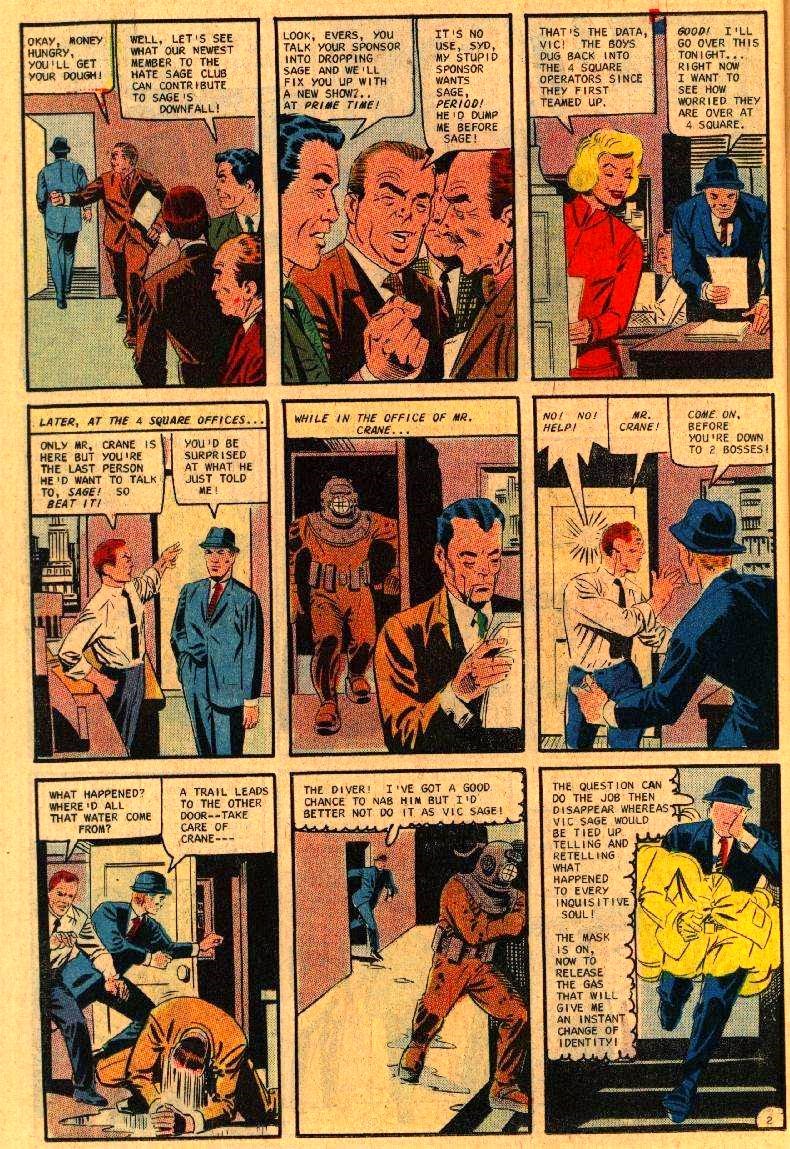
The Question Vs. The Diver of Death!

 Maybe it was just because of that Scooby Doo episode, but I’ve always thought old-time diving suits were creepy. I’m surprised no one’s made a slasher movie where the killer wears one! Which brings us to today’s offering, which pits a killer in a diving suit against The Question, who is a pretty frightening figure himself! Think about it, more so than The Creeper, Dr. Strange, Spider-Man or any of the horror hosts Ditko drew for Charlton, Vic Sage is easily the creepiest. At least those guys had faces! Or in Spidey’s case, a sense of humor. Check out the bit on page six where our hero laughs insanely at the villain; it’s scarier than anything the villain himself does!
 This story initially hints at a possible supernatural cause for the killings, but never quite runs with it. Still, after having binge read a stack of  Midnight Marquee’s Forgotten Horrors book series and seen what some folks consider horror, trust me, this story has plenty of horror content.
 Enjoy, and remember, there is only white and black, with no shades of gray!

Wait, isn’t that another ruthless, masked Ditko reporter hero’s shtick? Oh, Steve.
 
 From Blue Beetle #3. By the way, I made up that "Diver of Death" title, just because.


Wednesday, October 1, 2014

"I Spent Midnight with The Monster on Bald Mountain!"

It’s the first day of October, time to kick things in to high gear!
 I was trying like crazy to get reviews done of DC’s Mysteries in Space Fireside anthology and Rocket Raccoon’s 1985 mini-series before September ended, but everything just kept holding me back. Rest assured though, unlike last year, November and December will be very busy months (especially the former). Besides, after covering Green Lantern, Captain Mar-Vell, Guardians of the Galaxy and Fantastic Four, it’ll be nice to post something not related to space for the first time in months!
 Here’s a moody little Ditko yarn filled with all the perfect ingredients for this month; a grimy old castle, a genius tampering with forces man must leave alone, lightning, dark shadows and things that live but should not. It’s also interesting how this story, credited only to Ditko (although the dialogue is obviously not by him) reflects his Objectivist themes of absolute Good and absolute Evil in its two opposing sculptures; themes he would beat to death in Blue Beetle and Mr. A, and in one Blue Beetle story that featured sculptures (and a cameo by the Question!):
 
 From 1959, here’s “I Spent Midnight with the Monster on Bald Mountain” from Tales to Astonish #7 (originally entitled “I Spent Midnight with the Thing on Bald Mountain”). All © Marvel. Enjoy! This isn’t the last of Ditko we’ll see this month.
 

Thursday, July 31, 2014

Guardians of the Galaxy Origins: Marvel Super-Heroes #18

 Oh Guardians of the Galaxy. How you have haunted my comics-reading life. I’d be lying if I claimed I was ever a fan, but like Captain Marvel, the Guardians are figures that have kept popping up on the fringe every now and then. I own Marvel Super Heroes #18, the first appearance of the Guardians, I own Marvel Presents #3 (their first major solo appearance after MSH) and I own the first issue of their 90’s series.
 The strange part though, is that I didn’t end up with any of those comics because I cared about the Guardians themselves. I bought Marvel Super Heroes #18 because of the Golden Age reprints in the back of the book, and the Marvel Presents #3 and Guardians #1 both came in a “mystery box” of comics I bought at a garage sale. I actually tried to sell the Marvel Super Heroes #18 several times because hey, first appearances always sell, right? Not if no one knows who the characters are! Now all these years later, a movie comes out featuring this team I own the key ‘first” issues of (which usually =$$$), and except for Yondu (who sources indicate will play an antagonistic role) not a single member of the original team will be used in the movie.
 Life’s a bitch, ain’t it?
 Still, despite my financial disappointments (over used comics I bought 20 years ago) and the film featuring characters I’m mostly unfamiliar with except for Groot and Rocket Raccoon, I have to say I’m still eager to see the movie.

 Love ‘em or hate ‘em, there’s no denying that the Marvel Studios films are here to stay, and while the same thing was once said about Raimi’s Spider-Man series or Nolan’s Batman series (before he announced that he was only going to do three films), the consistently strong box office and favorable reviews have made it clear that, even if they hit a snag, we aren’t going to be seeing the last of these movies for a long time.

 The Guardians film, more than any other, marks a turning point. Think of the incentive and confidence it will give Marvel to tap into other obscure properties if it is a success. We could see movies based on Moon Knight (maybe they could introduce him first as the villain in a Werewolf by Night film), Agents of Atlas, or hell, since it’s been confirmed he’ll make a cameo in Guardians, maybe even a good Howard the Duck movie. (You could argue that the success of Blade should have started this all the way back in the late 90’s, but honestly, did anyone who went to see that movie know it was based on a comic? Do any of the fans of those movies know that now?)

 On the other hand, if it fails, don’t expect to see anything other than the major Avengers-related characters onscreen for the next few years.

 So with all that said, let’s take a look back at the first appearance of the Guardians in 1969. Ah, 1969, when men were men, women were women, Black Sabbath was no longer Earth, hippies were mass-murderers and Gene Colan was John Buscema:
 The story starts off in the year 3007, where all Earth nations have joined together as the U.L.E (United Lands of Earth) and set up colonies on different planets where the inhabitants are modified at birth to survive. We are introduced to just one such of these humans; Charlie-27, who was raised on Jupiter and has a bulky, square-shaped physique to withstand its pressures. Returning from a trip, he arrives home only to find that his planet has been conquered by a race of reptilian creatures called the Badoon:
 The Badoon have forced most of the Jovian colonists into concentration camps (including Charlie's father), while the others are forced to mine uranium without protective suits:
 Charlie manages to escape by using a teleportation device to warp himself over to a random planet, where he is saved from the Badoon’s “Saturnian Hound-Hawks” by Martinex, a colonist altered to live on Pluto who has crystals for skin. Although the Plutonian and Jovian colonies have centuries of bad blood between them, they agree to work together:
 The story then shifts over to Earth, where we meet the Badoon commander Drang and his erstwhile prisoners (and the true protagonists of the piece); Major Vance Astro and his servant Yondu.
 Astro is forced to wear a purple copper suit (which sometimes appears to have a mouth and other times does not) to sustain his life, and the story of how he ended up wearing it is not only a supreme example of tragi-comedy, but one of the darkest origins in all of Silver Age comics. I’m not even going to summarize it, read for yourself:
 Damn.
 Despite being time-displaced by millennia, Drang nevertheless is willing to give Astro employment and power if he betrays the rest of the human race, who have set up a small resistance group. Astro appears to comply at first since all the people he knew are centuries dead, even selling out Yondu:
 However, it’s all just a ruse and Astro and Yondu escape. Astro is not as unfamiliar with current technology as the Badoon would think:
 They then meet Martinex and Charlie and, typically for Marvel, mistake them for bad guys and a fight ensues.
 Also typically for Marvel, they then realize the error of their ways and join forces quickly. Escaping the Badoon guards, they set out to find the rebel colony and sing a modified version of “We Shall Overcome”:
 And that’s that.

 As we all know, the Guardians of the Galaxy didn’t exactly grip the comics reading public, with their longest-lived series not coming about for two more decades and the incarnation of the team that caught Hollywood’s notice consisting of entirely different characters. As a stand-alone work of fiction, it’s a pretty typical pulp sci-fi tale, not much different from the kind of series that would have run in Planet Comics back in the 40s (In fact, Planet Comics’ old Lost World series seems to have been something of an influence, with the Badoon substituting for the Voltamen) and the usual Marvel formula of heroes fighting over a misunderstanding and then becoming fast friends is repeated here.

  Nevertheless, the debut story of the original Guardians is fascinating for several reasons. The idea that humans would have to drastically alter their bodies in order to successfully colonize and live in the atmosphere of other planets, although not an idea original to Drake, is a hard sci-fi concept that one rarely sees addressed in books and films, and even rarer in comics, particularly Silver Age comics. The tragic circumstances of why Vance Astro must wear his costume are also amazingly dark for the time. His whole origin story is essentially a Weird Science twist-ending (or a twisted parody of Buck Rogers, depending on your point of view), and the fact that he can never remove his suit makes Tony Stark’s problems seem trite in comparison. If he had betrayed the rebels to Drang, he would be a compellingly tragic villain.

 Another interesting aspect not often mentioned about the original Guardians is that they are probably comicdom’s first true team of “freak” heroes.
 
 It is true that the X-Men and the Doom Patrol pre-dated the Guardians (and considering that Arnold Drake wrote this, the Doom Patrol couldn’t have been too far from his mind), but the whole “X-Men are treated as freaks/X-Men are a metaphor for minorities” thing didn’t really come about in the original series much except for a few out-of-place scenes that could just as easily be found in Fantastic Four and Avengers. Even the whole Sentinels storyline was really just a prolonged variation on the standard “Public turns against the heroes until an even worse menace is created” plot. Instead of being discriminated against, you were more likely 99% of the time to find scenes of the public asking the X-Men for autographs, drooling over Marvel Girl, teenyboppers swooning over The Angel’s blond good looks or hippies trying to draw on The Beast’s big feet. The rare times that humans were shown hating mutants often felt tacked on, like the mob sequence in X-Men #8. I’m not saying that a subtext wasn’t there, but it was focused on in the 60’s about as much as Bruce Wayne’s angst over his losing his parents was in pre-Bronze Age Batman comics. I could write a whole essay about this, and probably will.

 The Doom Patrol definitely had tragic origins that made them outcasts, and certainly would be frightening to look at in real life, but most of their stories were showcases for Drake’s absurdist sense of humor and surreal imagination. Quite a contrast to Byrne and Morrison’s grim takes on the characters.

 Either way, my point is that the X-Men and Doom Patrol were all either fairly normal-looking, or the few who were abnormal-looking were non-threatening. The Beast and Iceman, the most inhuman appearing of the X-Men, were generally played for comic relief and were handsome in civilian guise. The other members of the team were all traditionally good-looking. Robotman was also made a cuddly presence in Doom Patrol. Even Negative Man was drawn to look cute underneath the bandages, showing a whole array of facial expressions. Elasti-Girl was a glamorous movie star in her civilian identity. You wouldn’t mind being around them, or being them despite their painful origins.

 The original Guardians though, truly are grotesque and freakish. Charlie-27 looks like a human compressed into a square shape, Martinex’s vaguely defined features and segmented, crystalline structure make him look like a grotesque cross between Iceman and Batman villain The Outsider and far eerier than either of them, Vance Astro is a man trapped in an inexpressive suit that makes him look more like a robot (or Superman villain the Parasite), than a hero. I couldn’t imagine anyone wanting to be him. In fact, it is Yondu, oddly enough, who is the most normal-looking, despite being characterized as the most primitive and uneducated. All of them are the last of their kind in a sense (even the human Astro is the last living man from the twentieth century), with all the other members of their “races” dead or imprisoned. All of them would be misfits wherever they were to go.

 Perhaps it was this very aspect that was the reason the original Guardians were never a major hit, just like DC’s even more freakish-looking (and even less successful) Outsiders from First Issue Special #10.
 Another fascinating aspect of the Guardian’s debut is Drake’s vision of the future. All of Earth’s nations have united and we are specifically told by the narration that there haven’t been any wars. Normally this would imply some kind of peaceful, idealistic Utopia, but Drake never forgets or tries to overlook human nature. There are mentions of “New Paris”, “New Moscow”, “New New York etc. Clearly, there was a lot of blood spilt to create this ‘U.L.E’.

 Nor are racial or class conflicts depicted as a thing of the past, despite “We Shall Overcome” having changed to “Earth shall overcome” over the years. This is demonstrated briefly by mentioning the conflict between the “Jovians” and the “Pluvians”; they have even created their own slurs for each other. You can bet that if humanity ever does split into subspecies like this that it will just leads to new forms of racism, despite all the talk about “transhumanism” these days and claims that it will end racial conflict. Casual racism too can be observed in the hurtful things Astro says about Yondu, even if they were a bluff (Although then again, Yondu is written as a Tonto-like “Noble Savage”). We also see “robot servants”, but since normal labor jobs are shown to still exist and not made obsolete, apparently they are something only the very wealthy can afford.
 
  I wish more writers of futuristic space epics spent as much time on world-building as Drake does here, rather than simply making everything black and white, with the future being either a Utopian paradise or a Dystopian hellhole which has to be rebelled against, and Drake manages to achieve this in a story about rebels fighting a dystopian hellhole.

 All in all, while the original Guardians story isn’t great, and has even less potential as a film series than, well, a film starring a tree and a raccoon, it still offers up a truly fascinating vision of the future that’s neither too hopeful or too cynical, as well as a team of “freak” heroes that really are freakish for once. For fans of bizarre and unusual Silver Age comics, it’s one of Marvel’s most fascinating failed experiments.
 
 And let’s hope “failed experiment” isn’t a term that will be applied to the movie after it opens tonight.
 

UPDATE: Saw it opening night, and just went to see it a second time tonight. Loved it both times, and there’s really nothing for me to say that hasn’t already been said. In fact, I’m tempted to call it my favorite of all the Marvel Studios productions along with Winter Soldier, but it’s a bit too early to make that call.
 The doors are open. The Marvel Cinematic “Universe” has truly begun. Let Fox keep Fantastic Four and it’s supposed “grounded/found footage” approach, comic book movies that aren’t afraid to be comic book movies are going to be the norm from now on! Bring on Adam Warlock, Mar-Vell and Thanos!


Friday, May 9, 2014

Captain Marvel Masterworks Vol.1 review

There are some characters that just seem to haunt the fringes of your interest in comics until you finally decide to explore them in depth. While I’m not too keen on DC/Fawcett’s big red cheese, and I don’t find MF Enterprise’s “SPLIT!” version to be the campy masterpiece some praise it as, I’ve always seen Marvel’s ‘Space-Born Super-Hero” as the Captain Marvel, even though, as everyone points out, Marvel created him to secure copyright to the name. Granted, my fondness could stem from my first continuous exposure to the character being Jim Starlin’s acclaimed run and the good captain playing big roles in ‘important’ stories like the RoyThomasBrainFart Kree-Skrull War, or maybe it’s because, courtesy of a flea market, I ended up owning his first two appearances in Marvel Superheroes #12-13, as well as issue #4 of his own title where he fights Namor. Now, I fully admit I picked those books up because of the Golden Age reprints and because I go crazy for Gene Colan art and even crazier for Namor, but I always liked them because of the series’ gimmick, even though there were things in those stories that even as a teen I couldn’t suspend my disbelief about.
  Captain Marvel was about Mar-Vell; a member of an alien race called the Kree who came to Earth, took on a secret identity as a scientist and wound up becoming a superhero. On paper, it’s not too different a concept from lots of other alien heroes, going all the way back to Superman himself, and Cap’s costume wasn’t too markedly different from that of other spacemen like Adam Strange except for being in secondary colors.
 
  No, what made Mar-Vell unique was why he acted as a superhero. It wasn’t that he was raised by humans, or was an intergalactic policeman who decided to study our methods, or who fought crime since he was stuck here and believed evil should be eradicated no matter where it was, or because he was struck by the beauty of human life. Nothing like that. Mar-Vell was a soldier on a reconnaissance mission whose entire goal was to spy on us, and if need be, blow us all to kingdom come if we ever came anywhere close to developing weapons that could challenge the Kree empire.
 He only came off as a hero because his asshole superior officer, Colonel Yon Rogg, wanted to bang his girlfriend Una, so Yon-Rogg kept trying to force Mar-Vell into situations where he would be killed or forced to abort his mission (an offense punishable by death in Kree law), such as activating big homicidal robots to kill people who Mar-Vell was merely supposed to study, or tricking enemy alien races into attacking him. Mar-Vell would then fight these various menaces (mainly out of self-preservation and because he believed in sticking to the original plans to simply spy on Earth’s people, not kill them) and, to the unknowing populace of Earth, Mar-Vell would appear to be a benevolent superhero defending them.
 This could have been turned into a comedy series where the evil alien always ends up doing good by accident, or Invasion of the Body Snatchers-style horror; where the people of Earth have no idea that their champion is an alien spy. But the thing was, Mar-Vell was torn up inside because of this. He knew that, other than to Una, he was just another grunt to the Kree, while to the people of Earth who he was supposed to view as the enemy, he was appreciated and acclaimed as a hero, and noble soldier that he was, he couldn’t live with betraying trust, since he was a firm believer in showing honor even to his worst enemies. Even worse, he knew that eventually, he was either going to have to destroy us, or Yon-Rogg would find some way to make him look bad in the eyes of the Kree higher-ups and he’d have nowhere to go (if the Kree council didn’t kill him first).
 The final panel of #4, where Mar-Vell speeds off after battling Namor, the true hero of the story, and considers the tragic irony of his situation, always stuck with me for some reason.
 Many years later, I got a hold of the first Marvel Masterworks volume of CM, read up to the fourth issue (which I was already familiar with), and then, due to a bunch of factors, didn’t get a chance to finish reading and sort of forgot about it.
 
 That, however, has been rectified.
 
 And you know what? For a character created just to secure copyright, these stories are pretty damn good!
 
 Oh sure, there are plenty of ludicrous coincidences that even as a kid I found hard to swallow, namely, Mar-Vell conveniently happening across a dead rocket scientist named Walter Lawson who looks exactly like him and who he then impersonates to get access to Cape Canaveral.
 At the same time though, there are also some nicely realistic touches like a hotel clerk who becomes suspicious of Cap being a spy after noticing that ‘Lawson’ has no idea how to properly register, often uses false names and doesn’t handle money well (an interesting subplot that sadly gets hand waved a bit too easily), or people at the cape falling for the ruse, but admitting they detect something subtly “off” about ‘Lawson’, from the way he doesn’t understand various social norms or seems too forced in his slang, while others just write off his weirdness as harmless eccentricity, like a cab driver named Chester whom he befriends. There are also some nice moments of humor, such as Mar-Vell coming to appreciate mankind’s greatest achievement: The Coffee Break.
 

 The characterization of the supporting players is also quite good, and the situations created for them are handled uniquely. Carol Danvers, later to become a super heroine called Ms. Marvel (among several identities) is introduced here, and she’s as different from your typical female supporting character of the time as it’s possible to get. She’s a full-time working woman employed as the cape’s head of security, and although she needs to be rescued now and then, so does pretty much everyone else. Mar-Vell is the only one who knows how to stop the various alien threats that pop up, so having any human character defeat them on their own would come off as a stretch. And best of all, there is no romantic subplot….at first, but again, how it’s handled is quite unique. She doesn’t come to fall for ‘Lawson’, as she suspects him immediately and thinks he’s a spy (which he is, just not for the Russians), and there’s no attempt to portray her as secretly having feelings for him. In fact, next to Yon-Rogg, she becomes the biggest thorn in his side, with each time she appears building up tension. Using a female character in such an antagonistic light without making her a villain or a Lois Lane-type isn’t something you saw much in this era.
 However, Carol does end up falling for Captain Marvel. Again, this is handled in a far from typical manner. She’s just as suspicious of him initially as she is of ‘Lawson’, but because he saves her life several times, demonstrates his noble qualities and displays the grudging respect he has for her that he couldn’t show as Lawson, she gradually ends up falling for him over the course of many issues, without it ever coming off as forced.
 
 But here’s the thing; Mar-Vell does not at any time reciprocate her feelings or show any sign of falling for her (As Walter Lawson, he does occasionally make flirtatious remarks, but he’s clearly trying to keep her away from him by making her think he’s a sexist pig). He remains loyal to Una, and his attempts to protect Carol in particular are simply a combination of respect and because he’s afraid she might stumble onto something if he’s not around. However, Una sees them together and starts to worry that she might seduce him. Una could easily have been portrayed as jealous or unreasonable, possibly even ending up trying to kill Carol or betray Mar-Vell (remember all those times Lady Dorma would betray Namor or try to kill Sue Storm?), but instead, she’s portrayed with nothing other than sympathy. Her fears of losing Mar-Vell seem completely reasonable based on what she has to go on, and when she sees Cap kissing Carol (she forced herself on him and he immediately tries to pull away), it’s a legitimately heartbreaking moment.
 Una is also far from the typical weepy love interest (aside from a few lines about her feeling a ‘woman’s weakness”). She’s portrayed as a brilliant scientist and Mar-Vell’s go-to-gal for technology, and uses her expertise to get him out of several jams. She also gets one awesome moment where she knocks Yon-Rogg and his entire crew out with gas to buy Mar-Vell more time. It’s also made clear that she’s fully aware of Yon-Rogg’s lecherous designs on her, and even at her most paranoid about losing Mar-Vell, she’s smart enough to never trust Yon-Rogg or confide in him. In other Marvel series, she would probably end up falling for him in a fit of grief, or at least pretending to in order to make Cap jealous. Not here. There’s a lame subplot about how she and Mar-Vell are the only members of the Kree race that can feel emotion, but thankfully that isn’t dwelled upon much.
Yon-Rogg himself is easily the most despicable villain in late 60’s Marvel. He has no depth other than being a jealous, glory-hungry bastard, but you end up truly hating him on a level you don’t for say, Doctor Doom, because his evil is a real world, every day evil, and all of the drama in the stories come about from the emotional tension he creates, not because of his powers or latest super weapon. The way he mockingly tries to convince Una that Mar-Vell is cheating on her, or orders Cap to wipe out a city with a virus to prove his loyalty, or tries to get Cap in trouble with the Kree council really, really makes you despise him. A common reaction I’ve seen from people reading Silver Age Marvel is that the fights with supervillains often seem like distractions from the real drama that takes place out of costume, and that you often want to see supporting characters or ‘employers” like J. Jonah Jameson, Senator Byrd or General Ross pummeled more than the actual villains. Since Yon-Rogg is both villain and supporting character/employer, he comes off as far more compelling.
 Roy Thomas writes the first four issues and the second appearance, and he does a fine job. His purple prose is perfect for the space opera/soap opera going on, and he gets in several great lines which really capture Mar-Vell’s loneliness and inner conflict. He does however, have a tendency to reuse familiar characters as antagonists too much (something he admits to in the introduction). First we have the Sentry, The Super Skrull and Namor (all Fantastic Four-related characters). Things pick up when legendary DC oddball, Arnold Drake, takes the reins. He comes up with some interesting foes like a Soviet monster called the Metazoid, a living solar flare called Solam, alien pirates and a robot created by the real Walter Lawson (who it appears was far from saintly, or sane). Drake does reuse familiar Marvel villain Quasimodo the living computer, but gives him the bizarre gimmick of seeing himself as the ‘liberator’ of machines. Seeing him talk about the oppression of his “brethren” (drills, heaters and power tools) is just the kind of looniness you’d expect from Drake’s Metal Men and Doom Patrol, and makes him a lot more interesting than the rather vaguely defined villain from the Fantastic Four annuals.
  The Metazoid story is the one that most impresses. The Metazoid is portrayed as a tragic figure, an ordinary man arrested by the KGB and put on trial for speaking out against the USSR, then mutated into a monster and sent to abduct Lawson to prove his loyalty; if he fails, he will never be made human again. The Metazoid’s plight provides a fascinating counterpoint to Mar-Vell’s conflict with Yon-Rogg and his turmoil over whether to prove his loyalty to the Kree or to do the right thing. The fact that neither Cap or the Metazoid ever realizes the similar situation they are both in is a nicely mature little touch. It doesn’t end happily, and succeeds in creating a genuine feeling of ambivalence in the reader. It’s so good, you can easily forgive the Metazoid’s vaguely defined powers and appearance (is he made of rock, fur or tar?).
 The artwork is excellent throughout. Who knew Gene Colan “comic's prince of darkness” (as Wizbang called him) could be so good at space opera? Much maligned inkers Paul Reinman and Vince Colletta also do a fine job. This Masterworks edition features photocopies of Colan’s pencils before they were inked, and although they do look more impressive prior to inking, that was pretty much the case with every Colan inker. Reinman’s scratchy style gives things a rough-hewn, gritty mood, and although I’ve heard that Colan hated Colletta so much he sometimes went back and re-inked his own work, all I can say is that either he found time to do it for every issue here, or Colletta’s reputation for erasing is exaggerated. This stuff is fantastic.
 Don Heck takes over with the fifth issue (also the same issue where Drake arrives) and seems much more comfortable on this strip than with The Avengers, which is where most of Heck’s poor reception comes from. Heck was a fine artist, just admittedly not a superhero artist, more suited to science fiction and romance (You could always tell he enjoyed drawing Tony Stark more than Iron Man), so he’s at home here. Like I said before, some of his character designs are kind of odd, but then again, what is a ‘Metazoid” supposed to look like anyway? This is some of his best work.

 I really, really enjoyed this volume. Some people really hate this series, calling it a cynical copyright grab, or “a foray into sustained tedium”, often by pointing out the radical changes the premise would undergo (Mar-Vell eventually ended up becoming a space wanderer, an approximation of the old Billy Batson/Shazam concept, then a cosmic philosopher) as proof that he was a “nothing” character without a unifying concept. It may indeed be true that those abrupt changes destroyed the series (I haven’t read many of them and can’t comment), but I have to say, there’s nothing wrong with the original premise presented in these stories at all. It’s one of the most compelling (and grim) ideas for a ‘space hero’ series I’ve seen, and as long as it lasts, I think I’ll enjoy reading more of these collections before getting to the Starlin stuff. There’s nothing to be ashamed of here at all. 4/5.