Sunday, July 21, 2013

Atlas Era Heroes Vol.3 review


While it’s pretty common to blame corporate greed for everything bad that’s happened in the comic book industry, there have also been cases where it’s led to some artistic highpoints. One of these came in 1953 when Martin Goodman decided to revive his big three superheroes of the 40’s; Captain America, The Human Torch and The Sub-Mariner. Although Goodman obviously thought that the Torch would be the most popular (He was spotlighted on the covers of Young Men #24, the comic that led to the revival) and Captain America is the most remembered today because of the over-the-top anti-communist stance of the stories (Just one of the many EEEEEVILs of Stan Lee’s career that Kirby Kultists like to cite, even though Fighting American was no less jingoistic), the Sub-Mariner ended up becoming the highlight of the revival. Why? Well, apparently there were plans for a Sub-Mariner TV series, which led to Goodman making sure that Sub-Mariner’s own title stayed afloat (If you’ll pardon the pun) for a longer time than Cap and the Torch’s did. The Cap & Torch revival titles only lasted three issues apiece, while Subby’s lasted a full ten, well after the Comics Code actually. The TV series never came to pass, but oh, what a glorious ten issues those were!

 Bill Everett has already been contributing some outstanding art to the Sub-Mariner stories seen in Young Men and Men’s Adventures, but here, with a comic devoted entirely to his own character (except for some back-up features), he had a chance to really cut loose. In some ways, this was the highlight of his entire career.

 And best of all, since the anthology titles and Cap and Torch stories were already collected in the previous two volumes of Atlas Era Heroes, this volume is nothing but issues of Sub-Mariner’s own title. As Roy Thomas says in the introduction, they really saved the best for last.

 Just look at this stuff:
 
 I love the little touches like the wavy panel borders that make it look like each panel is being depicted through drops of water. I’ve seen Everett do this on some of his non-Sub-Mariner comics during this time period, but here it just fits.

 But these comics don’t just stand out for the art; Everett makes his mark in the writing as well. It may not be everyone’s definition of good writing (Everett has a real problem with explaining some of his more bizarre plots, although in some cases that enhances their effectiveness), but you wouldn’t mistake these stories for those of any other character on the stands!

 One of the things that stands out is the characterization of Namor himself. I said in my review of Golden Age of Marvel Comics Vol.1 that Namor was treated as more of a straight-up superhero during this era than he was in the past, with only a scant mention of his villainous beginnings. Basically he was like Aquaman, only more badass. However, while that may have been true at first, Everett was always a wild-card, and he wouldn’t keep his hero tame for long. Everett once told Roy Thomas that he looked back at his early Sub-Mariner work and said that he found it lacked depth and was just the venting of an angry young man. While one can definitely see why he’d think that about the earliest Sub-Mariner stories, the sense that he was venting was also apparent here as well (Even though things are far more polished). Everett drew these stories during the early 50’s, when he was married, had kids, and was doing very well financially, so for the most part, it makes sense to see a somewhat more heroic, conservative Namor who often acts as a government agent at the behest of his old love interest Betty Dean. But every now and then, Namor will get mad about something, and it will be right back to war with the surface dwellers. It seems inconsistent, but it lets you see Everett’s mind-set. When Everett is happy, Namor will save kids whose yacht sunk and cooperate with police while receiving accolades from the public as if he’s freakin’ Superman. When Everett is pissed about something, Namor will contemplate stealing world-destroying weapons from the villains so he can wipe out the human race himself!

 Sometimes Namor will be perfectly friendly initially, but be falsely blamed by humans, join up with the villains, then turn his back on them at the last minute. Him turning against the villains or giving up his plans of vengeance are not always motivated by some innate morality on his part either; in one story, all of Earth’s water is stolen by aliens, and when Namor gets abducted along with the water after being falsely blamed, he decides to let the aliens keep the water and let all of Earth die of thirst as revenge for blaming him! The only reason he lets Earth have its water back is because he realizes it will doom his own people. Namor returns the water, reluctantly saving the humans who still blame him, but at least back among his own race he is considered a hero, and welcomed back to his kingdom after being exiled earlier in another storyline. So…happy ending, I guess?

 There’s a lot of talk about superheroes being modern-day equivalents of ancient gods, and you can definitely see that in these Sub-Mariner stories besides the obvious classical influences like the legends of Atlantis (Although here, Namor’s kingdom is set specifically in Antarctica). Just like the gods of Greece, Namor can be mankind’s friend in some stories, in others; he can be its worst enemy over something petty. Everett may not have thought much of it, but he was doing something unique among superhero comics: Creating a character that the reader is fascinated by not so much because of the question of what others will do to him, but because of what he’ll do to others, and because watching Namor rage at the humans allows the reader (and his creator) to blow off some steam of their (his) own.

 It’s raw, somewhat juvenile, but in its own way, it’s just as powerful a form of self-expression as anything by Robert Crumb or Chris Ware (Or Fletcher Hanks...). Everett seemed aware that sometimes, kids just like seeing destruction and mayhem and aren’t always concerned with saving the world and helping out their neighbor. He tapped into the secret that makes anti-heroes like The Hulk and Wolverine popular. But he also doesn’t make humans out to be bad in order to make Namor look good, oftentimes some things are the result of simple misunderstandings on the humans part, and considering how temperamental Namor is, well, you don’t blame humans one bit for mistrusting him.
Flooding New York will do that to you Namor


 The character of Betty Dean, who always tries to be sympathetic to Namor but just can’t take it all the time, manages to be a good alternate viewpoint character for the reader when Namor starts to seem too unsympathetic.
 The Atlanteans (Yeah, I said they lived in Antarctica, but I’m calling them that anyway) are also shown to have their good points and bad points as well. Prince Byrrah, the Emperor’s step-son, is a jealous, spoiled tyrant who has all of Namor’s bad qualities with none of his good ones, ever hungry for war and glory, and driven by a childhood jealousy over Namor. It’s a fascinating pre-cursor to the Thor/Loki rivalry, except that here, Byrrah plays the Thor figure, since he is shown to have more influence than Namor with the Emperor and is always addressed as ‘Prince”, with it being implied that Namor’s weirdness (His human-colored skin) has made him something of an outcast among his own people, since he is only addressed as “Prince” among the humans and in stories flashing back to Namor’s youth.  Byrrah always plays the villain in these stories, but is always welcomed back by the time of the next story.
 That said, sometimes even the Emperor gets fed up with Byrrah’s crap, like in this panel that made me laugh out loud:
 Namor’s cousin Namora is also shown to be a spiteful, vindictive character in her own right as well, and betrays Betty Dean more than once (Although Betty can be quite jealous herself in some stories):
 A temperamental, unpredictable hero who isn’t always heroic and doesn’t always feel like he belongs, humans who unjustly (and sometimes perfectly justly) distrust the hero, villains with a connection to the hero on a personal level, subtexts of sibling rivalry, and multiple love interests with their own foibles. These were themes and ideas that were pretty much unseen in 50’s superhero comics, and in my opinion, elevate these stories above simply being outlets for Everett’s anger. More importantly however, they are all themes that would soon come to be commonplace at 60’s Marvel. Maybe Everett deserves much more credit for being one of Marvel’s architects than he’s been given.
 One thing I do have to say though; I seriously doubt these were things that would have cropped up in a 1950’s live action kiddie show starring Sub-Mariner, if they had ever really been serious about making one.
Hey kids! In this episode, Namor goes berserk and tries to exterminate the human race again! Same Sub-Time, same Sub-Channel!
 
 That aside, these stories are just fun, sometimes just for the art, sometimes just for the plots. Everett may have fused these stories with a lot of his own anger, but he also added a great deal of humor to them as well. His penchant for characters tossing grade school insults at each other during otherwise dead serious moments is always amusing, and some of the twist endings he comes up with for these stories are almost Eisner-esque. In one story, Namor risks his life to save a young woman from some commies who find her trespassing near their hideout. To all appearances, she is a government agent on these commies’ trail. It all seems like a fairly typical “hero rescues friendly agent from villains” story, until the twist ending is revealed about what the woman was really doing:

You never saw that kind of humor or creativity in Cap & the Torch’s contemporaneous stories.

Besides just dealing with Byrrah and communist agents, Namor also gets entangled with some truly bizarre villains like an undead queen who can only live underwater and turns to a corpse when she surfaces, a mad scientist and his Creature from The Black Lagoon-esque monster, an evil hypnotist who keeps Namor under his control for months on end, a robot double, a giant crocodile (who isn’t really all that evil) and the ghost of Jules Verne’s Nautilus, brought to life by a magician from a stolen painting!
 I love how Everett draws the Nautilus to look like the one from the recent 1954 Disney film so that readers would recognize it, but also goes out of his way to mention that it was inspired by a book by a French author. That information alone was probably more useful to kids back then than the Classics Illustrated version! (Was there a Classics Illustrated version of 20’000 Leagues?) Marvel really needs to bring that story into continuity and tie it into Fantastic Four villain Painter of a Thousand Perils, even though we never really find out anything about the magician, his methods or motives. That’s what retcons are for, though.
 Towards the end of the volume, Namor settles back into being a straight-up superhero again, but since the crazy plots keep coming and the entertainment value never goes away, it doesn’t really matter. Sometimes it’s fun to see a superhero traditionally portrayed as an outlaw or a grim character treated as a normal hero for a time. That’s what made those Silver Age Spectre stories so fun to read last year.

 Everett also shows an interest in world-building that few other superhero comics writers at the time did, such as a series of stories about Namor’s youth, exploring how he first discovered his powers, and his rivalry with Byrrah. Some are actually kind of whimsical, like this one story where Namor befriends a Frost Giant whom only he can see. There are some minor non-Sub-Mariner backup features as well such as some pretty lousy Human Torch stories, and after that, very short stories themed around sea life, with titles like “Octopus!”, “Shark!” or “Swordfish!” that all revolve around the animal in question. These are fun, but nothing to write home about.

 The reproduction of these stories is pretty fantastic, and the linework looks just as good, in fact, better, than the 60’s reprints in comics like Fantasy Masterpieces and Marvel Super Heroes (Which is how I first discovered them). Some of the coloring is a little off (Namor’s shorts are always blue, when they usually varied from green to blue in the originals, and the skin-coloring of the Atlanteans is strange to say the least, with Princess Fen being given human-colored skin, which she was a few times in the originals, but mostly by accident), but nothing too upsetting.

 This is a fantastic volume and gets my highest recommendation. 5/5.

Tuesday, July 16, 2013

Essential Man Thing Vol.1 Review


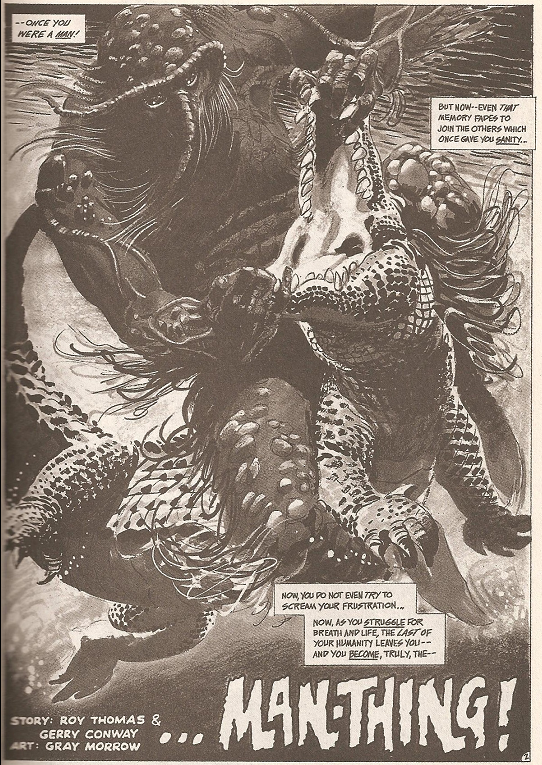
 How, oh how could I have gone on this long without covering this series? You all know how much I love muck-monsters in comics, yet rarely have I even mentioned what is easily comicdom’s third most recognizable such creature. I’ll be honest and admit that I’ve never been crazy about this character, but at the same time I’ve never really disliked anything involving him (Well, except for that awful TV movie); even the team-ups featuring the character have been surprisingly enjoyable considering that a passive character like Man-Thing would seems like he’d be most boring guest star in the world. Having just finished reading this essential collection in a record two days (Virus problems have been keeping me from using my computer lately) I was surprised at what a breezy read it was, especially considering the wealth of material on display here. We have black and white magazines, guest appearances in other character’s series, text stories, a horror anthology featuring Man-Thing as the lead, the character’s own title, as well as the two infamously named annuals that were called “Giant Sized Man-Thing”. What’s even more astonishing is that I remember reading a lot of these stories and enjoying them, but somehow I’d forgotten them. Weird, because these sure don’t seem like the kind of comics you’d just forget!

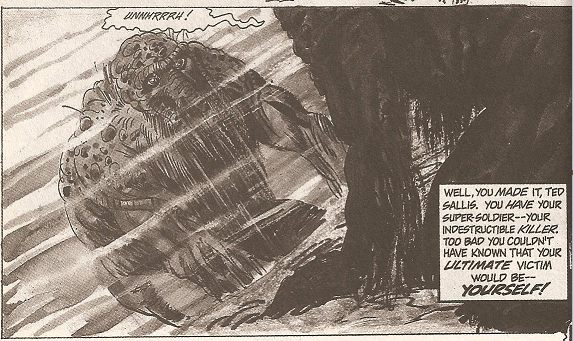
 Man-Thing is frequently compared to DC’s Swamp Thing in that both characters are scientists working on secret formulas that get attacked by spies and turned into monsters. Details of Swamp Thing’s origin have gotten woven into Man-Thing’s over the years though, with Ted Sallis, the man who became Man-Thing, transforming due to a lab explosion or because his formula was somehow connected to plants. In the original origin story though, Sallis just transforms because he leaps into a swamp after his car goes off the road, while his serum was supposedly intended to create a super-soldier (And despite being firmly grounded in the Marvel Universe, never is it mentioned that Sallis was trying to duplicate Professor Reinstein’s Captain America serum, a detail that gets mentioned frequently in Man-Thing character bios).
 
  Man-Thing also differs from Swamp Thing in that he’s neither an action-oriented character nor the driving force of the stories he appears in. Man-Thing is a nearly mindless being who can sense the emotions of those around him and reacts to them. Thus, all of the stories depend on other characters to drive the course of the plots. In a way, Man-Thing functions as a kind of ‘host’ character who intervenes, like The Phantom Stranger, Spectre (in some incarnations) and The Spirit. This gives the writers a lot of leeway for telling different kinds of stories, and, oddly enough, the result at times feels closer to what Alan Moore eventually turned Swamp Thing into than what Swamp Thing had been before that (That isn’t to say that pre-Moore Swamp Thing was crap, or mindless action, in fact, I feel quite the opposite in that I prefer Wein & Wrightson’s stuff to Moore’s, but that’s a rant for another time). The connection becomes unmistakable when later stories mention that the real reason Sallis became Man-Thing was because he was chosen to be a champion of the swamp by gods who guard “The Nexus of All Realities”, just like the Parliament of Trees from Moore’s ST run. I also know that Neil Gaiman was heavily influenced by some of these stories when writing Sandman.

 The series doesn’t start off quite like that, however. The first Man-Thing story highly suggests that when Ted Sallis becomes the Man-Thing that he isn’t mindless, just stricken with amnesia and/or driven insane, with no way of communicating. In fact, the ending of the first story is built upon Man-Thing reacting in horror at what he’s become when he sees his reflection, and the character’s next two appearances in Ka-Zar have him trying to protect a female scientist who he thinks can help him regain his humanity.
 Man-Thing’s infamous power of making whatever knows fear burn at his touch is also vaguely defined at first, initially seeming to have more to do with him being composed of chemicals rather than being triggered by other people’s emotions. Before long though, the premise is established: Man-Thing is a mindless creature drawn to wherever human emotion is strongest in the swamp, the bulk of the story then focuses on the human drama aspects and some kind of social commentary, and then inevitably it all ends with the issue’s baddie growing fearful, encountering Man-Thing, and thus, burning at his touch.

 Curiously enough, Steve Gerber (Who writes the bulk of these stories), a writer known for using comics as a springboard for all kinds of concepts, ranging from satire and absurdist humor, to philosophy, to social commentary, spends most of his Man-Thing stories in Adventures Into Fear focusing on a teenage girl named Jennifer Kale (Who comes from a family of cultists that worship a dead Atlantean priestess named Zhered-Na) who ends up caught in a quasi-sword and sorcery adventure involving a demonic villain named Thog (First simply called “Nether-Spawn”), a barbarian named Korrek, and a senile wizard called Dakimh. Gerber does do a few EC-like stories in between Jennifer’s adventures that play up his more well-known trademarks as a writer, but by and large, the focus is on Jennifer and her quest.
 
 This isn’t a bad thing necessarily, as there are plenty of Gerber’s trademark absurdist moments (In fact, it’s the epic conclusion of the Jennifer storyline that introduces Howard the Duck! He gets written out very quickly though), the storyline generates a fair amount of action and suspense, Jennifer and her comedy relief brother Andy are likeable characters, the backstory given to the Zhered-Na cult is fascinating, and you have to love how Jennifer’s Grandpa is depicted as a wise voice of reason, even though he’s the leader of a cult that could easily be the villains in a Dennis Wheatley novel or a Chick tract.
'It vaguely resembles a duck--but it seems more like something that would make for a horrible movie!'
 
  All things considered, the Jennifer Kale ‘arc’ is something that could have easily been told in a Doctor Strange comic without missing a beat, although part of me wonders if it inspired aspects of the movie Time Bandits.

 Ultimately though, it’s the one-off horror or social satire stories that work best. Gerber is about as subtle when it comes to making his points about the problems in society as James Cameron and Steve Ditko; in other words, he has absolutely none. For example, a greedy land-developer who becomes the series ‘big bad’ is named F.A. Schist. However, Gerber always goes out of his way to try and depict both sides of a problem and give the villains at least some depth. One story seems like a typical “Innocent black man is on the run from a racist white sheriff who framed him” scenario. There’s a twist though, while the white sheriff is indeed a racist bastard and the black man is a very sympathetic and likeable character, the black man IS guilty of the murder he’s been accused of, and not in a “It was just self-defense!” sort of way. Going with that twist took some major balls on Gerber’s part. Not all of the stories try to be that weighty though, one story involves a Superman analog who stayed in the spaceship that sent him to earth for his entire life, and once released, has a full-grown body but the mind of a baby. It manages to be both funny and genuinely tragic at the same time.
One of Gerber's more loaded stories
 
  Gerber really hits his stride once Man-Thing is given his own title and the Kales are written out of the book except for a few cameos. He introduces a new protagonist for Man-Thing to ‘protect’ named Richard Rory, an ex-disc jockey with some serious self-confidence issues who falls in love with a scarred but pretty biker chick named Ruth. Having a more down to earth human character for ‘Manny’ to shadow allows for more of the types of stories Gerber really excelled at, mainly because they’re more grounded in reality and aren’t trying to become an epic like the Kale saga. Of course, I say ‘grounded in reality’ in comparison considering that they involve deranged supervillains who think they’re the new messiah, scary clowns (Are there any other kind?) and other assorted weirdness. Still, these stories still try and be meaningful, even stories based around recurring villains like Schist, and Gerber is one of the few comics writers whom it’s fun to watch try and make each story a deep meaningful masterpiece, even though he flops more often than not at doing that. At one point he even tells the reader that he’s sick of trying to be philosophical and that next issue is just going to be a lot of goofy weirdness.
The tragi-comic Richard Rory finds (short-lived) love


 Also, we get to see Gerber’s attempt at poetry:
 
  I know what I’m going to read out loud at the local coffee shop on open mike night, next time I’m in the mood to prank some hippies! To be fair though, in-story, that poem was written by a mental patient whose hallucinations were coming to life.

 So for making an honest attempt at to tell stories and deal with things important with him, I have to give Gerber credit. In fact, it’s when he plays around with the traditional Marvel Universe that the stories are the weakest. Those two ‘Giant Size’ issues both deal with crossovers, one involving Marvel’s other resident swamp monster The Glob, and the other has cameos by Reed Richards and Tony Stark. The Glob story devolves into a slugfest, and the Stark & Richards cameos could have been excluded easily. There’s also a bit during the Adventure into Fear run where Hulk villain Mongu the Gladiator shows up in another dimension to do battle with Man-Thing. This doesn’t quite work however, since in Mongu’s previous appearance way back in 1962’s Incredible Hulk #4, he was shown to be a communist hoax. Oh well.

 Gerber does become pretty much the whole show, but special praise should be given to artist Val Mayerick (who draws the bulk of the stories in this volume). Mayerick is one of those artists whose work can look radically different depending on whoever’s inking him, but he has a real talent for mood and facial expressions, with a sketchiness that separates his work from artists with somewhat similar styles like Ross Andru. Mike Ploog is also quite good, and seems to have become the artist most associated with Man-Thing despite not really doing that much work on the series. Ploog utilizes a very cartoony style, looking somewhat like what would happen if Jack Davis collaborated with Bernie Wrightson. Oddly enough, this gives the book much more of a horror vibe; shadows are deeper, Man-Thing truly looks repulsive, hunchbacked and slimy, and little horror references abound, like a henchman drawn to resemble Rondo Hatton. At the same time though, Ploog isn’t always the best at drawing normal people. His depiction of the bespectacled Richard Rory sometimes looks as if Rory has huge square-shaped eyes instead of glasses, and he completely eliminates the biker chick clothing and deep facial scar which made Ruth a unique looking heroine.

 Speaking of inconsistencies, these stories are hilariously little inconsistent as to what Man-Thing can and can’t do. The origin leads us to believe that Sallis’s body was mutated to adapt to his new swampy environment and that Man-Thing isn’t really made of plant matter, just coated in it, but other stories show him displaying plant-like regeneration qualities. Even further, some stories treat him as if he’s made out of the slime itself, and he reacts like an amoeba (Or Plastic Man), slithering through cracks between crates and absorbing cars and tanks. Man-Thing’s reaction to fear also changes to meet the demands of the plot. There are a few suspenseful sequences where the good guys become frightened and Man-Thing almost burns them (Usually for the character to be saved by a distraction), but there are several stories where the heroes are obviously very, very afraid and Man-Thing does nothing. The amount of fear required to invoke Man-Thing’s wrath also changes. Sometimes just being startled will do the trick, other times someone has to be screaming their heads off or stricken with a full-blown panic attack. Several characters save themselves by overcoming their fear, while others are still pursued by Man-Thing even after they’ve lost their fear. In more than one story, the villain displays no fear whatsoever but still falls prey to Man-Thing because they were a coward in the moral sense. Man-Thing’s own ‘morality’ also changes. Sometimes he acts as a straight-up defender of the helpless, other times he cannot be goaded into action until he senses the evil or fear of the villains. In some stories he seems dangerously territorial, and in others, he’s so passive he’ll take any abuse thrown at him until he senses fear. The motivations of the villainous Schist, as well as Jennifer Kale’s age, also could have been better defined.

 Oh, and just a side note on the subject of Jennifer Kale’s age. Women and old-timers who complain about the scantily-clad heroines in modern comics and think this is a new phenomenon or one only limited in the past to black and white ‘adult’ comics like Warren’s Vampirella need to see Jennifer’s priestess outfit (Which appeared in full-color, CCA approved comics). The back of this volume includes bio pages of Jennifer and Man-Thing from Marvel’s A-Z list of characters which was published in the mid-80’s, and Jennifer is still listed as a minor (Meaning she’s even younger in these stories). How many of today’s supposedly sexist-to-the-max modern comics would put their teenage heroines in costumes like this?
"We'd like you to take a seat Mr. Dakimh..."
 
  I don’t want to give the impression that these inconsistencies affect the entertainment value of the book, but it would have been nice to have seen some set rules. Then again, considering how formula-driven this series is, being willing to play around with things was probably a good idea on Gerber’s part. It just would have been better to see more instances where Man-Thing’s wrath didn’t just happen to conveniently drive him to only go after the bad guys. That may have been done because of the Comics Code though. That said, for a code-approved comic, there are an awful lot of scenes of Man-Thing breaking people’s necks and burning them alive! Gerber can get surprisingly graphic in his descriptions of charred flesh (although the art never shows anything). Sure, all of the people who get killed by Man-Thing are bad guys and there’s nothing in these stories that wouldn’t be allowed in a PG-13 movie, but I can see why there’s a ‘Parental Advisory” warning on the back of this volume which few other volumes in the Essentials series have (Jennifer’s costume may also have played a role in that).

 Man-Thing also doesn’t just kill humans in these stories; he also kills so many gators that a whole montage could be done of it!
In your face PETA
 
  Inconsistencies aside, I really enjoyed this volume a lot more than I thought I would, and it was fun having my memory jarred on stories I’d forgotten. I actually have a desire now to revisit more Gerber comics (I haven’t read anything by him in years) and to seek out more Man-Thing compilations. What more can you ask of a volume than to leave you wanting more?

 4.5/5.
"Huh Huh Huh. He said "Giant-Sized Man-Thing".
 

Wednesday, June 26, 2013

"We're following the Piper, as we dance beneath the Moon..."


Today is June 26th.  Legend has it that on this day in 1284, in the town of Hamelin, Germany, a man dressed in many colors led the children of the town away with his flute, with only one boy whose leg was injured not being able to follow.
Oldest known painting of the Piper
 
Was this story true? Was it just a metaphor for the plague, or age, or did they just have pedo’s even back then? Whatever the case, the story of the Pied Piper has been one of the essential folktales of Western Civilization. Sometimes he’s been a heroic figure, other times he’s been a villainous figure. So today I thought I’d look at some of the skirmishes comic book heroes have had with villains patterned after the Pied Piper.

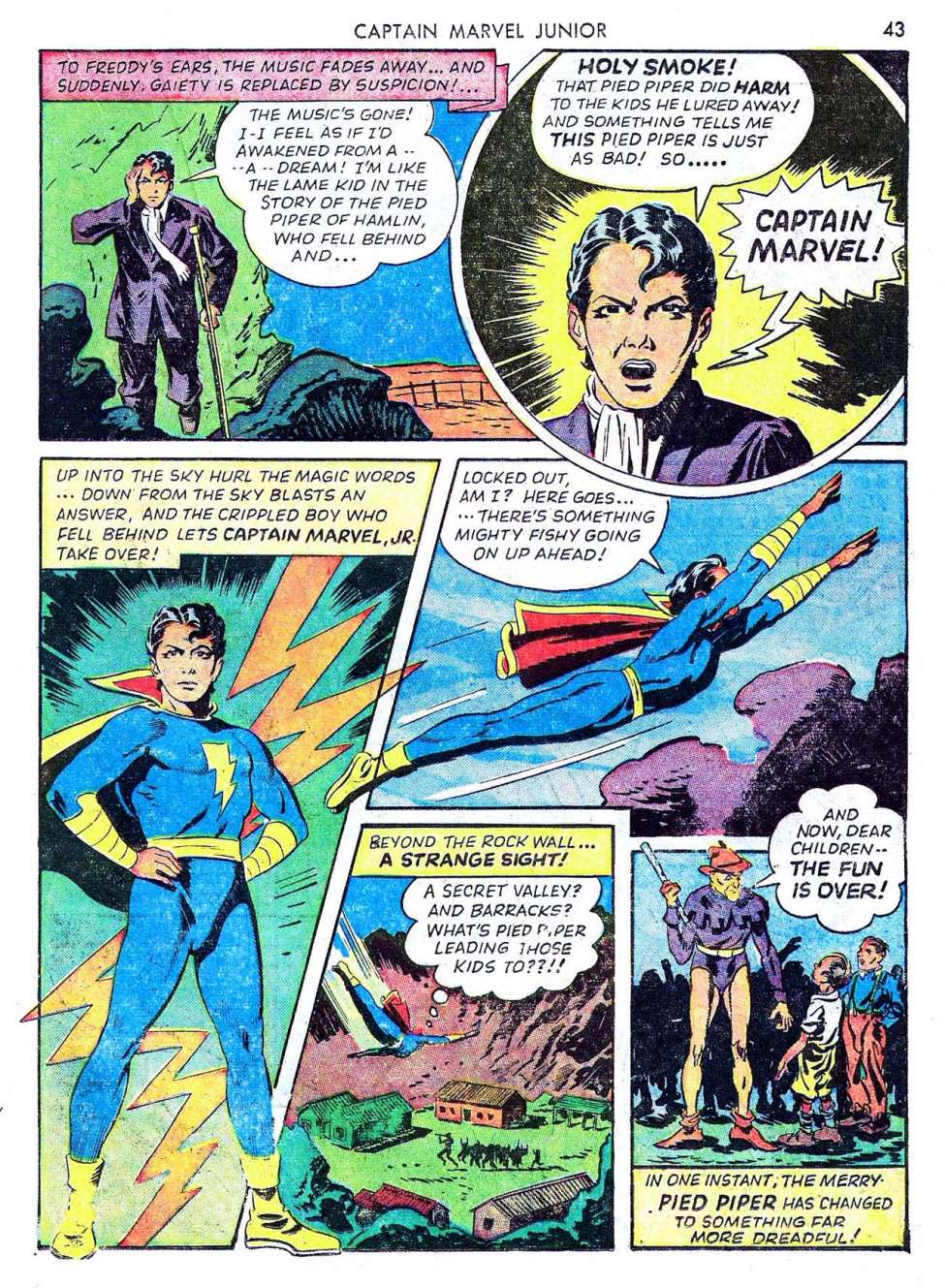
 While I’m not fond of the Marvel Family, I did enjoy the story “Pied Piper of Himmler” from Captain Marvel Jr #2. This Pied Piper was actually a Nazi trying to lure children away to be made into soldiers. This story made clever use of the fact that CM’s alter-ego Freddy Freeman also had an injured leg, making him analogous to the boy in the legend.
 
By the way, that’s Bernard Baily on art in this story. Who knew he could imitate other people’s styles so well? I could have sworn this was Mac Raboy’s work, because none of these panels have any of Baily’s usual idiosyncrasies when it comes to faces, etc…
Well, okay, maybe not all of them


  Over at Quality Comics, the Ray battled another Nazi Pied Piper in Smash Comics #17. This guy preyed on the homeless and dock workers instead of children.
 

  This story didn’t make as good a use of the actual legend as the Captain Marvel Jr. story, but who could complain when Lou Fine was doing the art?


  DC reprinted this in one of their 100 Page specials. Why the hell didn’t they choose this story for their Greatest Golden Age Stories Ever Told volume instead of that lousy Black Condor story? That’s some top-notch art, and a waaaay better introduction to Lou Fine.

 Over at MLJ, the Black Hood went up against a particularly gruesome looking Pied Piper in Jackpot Comics #7. If this guy looks familiar, it's because I’ve mentioned this story’s shameless Simon & Kirby splash page swipe before. I also apologize to Irv Novick (Who I blamed last time for the swipe), as it was Sam Cooper who actually drew this.
 
  And it doesn’t just extend to the splash page. Even the fight scenes and panel borders desperately seem to be imitating the S&K style:

  That said, this story distinguished itself with a gothic horror atmosphere, as this Piper targeted a wealthy family in a countryside mansion. There were several pretty creepy scenes of him hypnotizing people into killing themselves, which Cooper rendered by depicting the victims as looking like white-skinned, blank-eyed zombies! (And for all I know, maybe that was a swipe of the ‘Hollow Men’ from the Cap story in All Winners Comics #1). It still made for a fairly effective story.
No Black Hood, that's not you make the 'Y' in YMCA


 And just as how Batman would later battle a Mad Hatter obsessed with pipes but not Alice in Wonderland, Batman also battled a Pied Piper obsessed with (smoking) pipes with no connection to the legend! (I admit I haven’t read this story in a long time, so I could be wrong). A team up between this Piper and the mustachioed hat-obsessed Hatter needs to happen someday. Where’s Brave and the Bold when you need it?
 
  By the way, there was also a heroic Pied Piper who featured in Holyoke’s Cat-Man Comics. He was a framed attorney who decided to clear his name using a magic flute he had conveniently laying around in his antique collection (Oh, Golden Age…). His costume simply consisted of a fedora and sunglasses.


 For such a low-key hero, most of his stories had an occult theme. In one story, he battled a vampire who was not only real, but bore a striking resemblance to the Green Goblin as he was depicted in Spider-Man: Turn off the Dark!

 
  Of course, the most famous Piper in comics is Flash’s sometimes friend, sometimes foe. And for a special treat, here’s his debut from Flash Comics #106! All © DC.


 Man, Carmine sure loved the Hokusai wave, huh?