Collecting: Showcase #60, 61, and 64. The Spectre #1-10. Adventure Comics #431-440. Brave and the Bold #72, 75, 116, 180, 199. DC Comics presents #29. Ghosts #97-99.

I’m just going to quote the homeless-looking man who had wandered into the comics shop when I was purchasing this thing:
“Dayum! Thassa big motha’ right there! You gonna read all that?”
Yes, at nearly two inches thick, Showcase presents The Spectre is one huge volume (spanning from the 60s to the 80s), and yes, I did indeed read all of it. Even the Fleischer/Aparo run from Adventure Comics that I’ve already re-read a million times since I was a kid.
And I loved every bit of it.
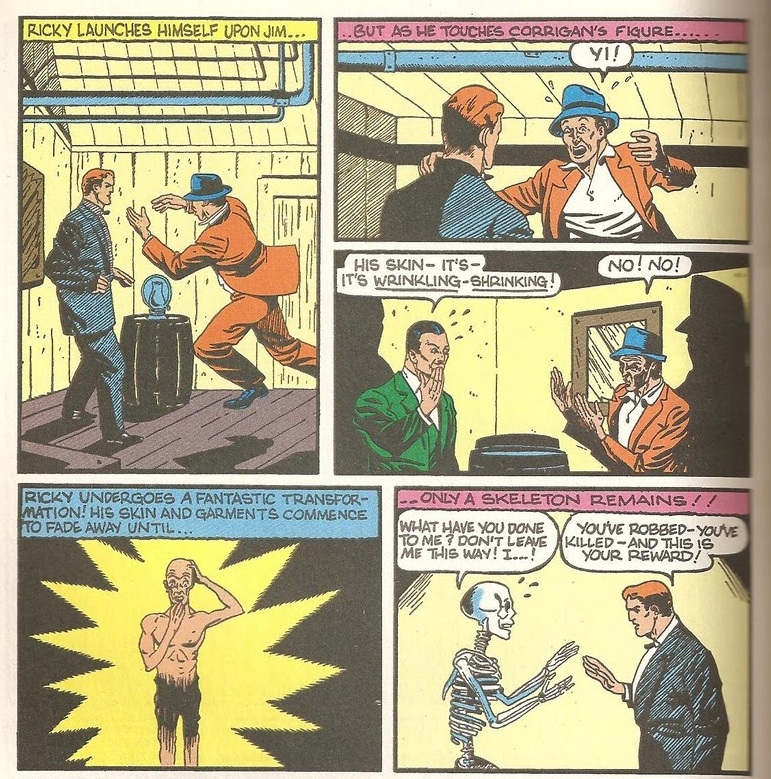
I’ve read bits and pieces of the 60s run (which is what kicks off this volume), and enjoyed them, but I never knew how well they all held up when read in sequence. Some people have criticized the 60’s Spectre revival for making him more of a cosmic superhero than a ghastly ghoul, but hey, it was the 60s, so Spec couldn’t exactly go around melting people’s skin off and crushing cars with his hands like he did in the 40s. Don’t worry though, the ace of shades has plenty of occult goings on to contend with in these stories, more than enough to whet the appetites of any horror fan.
Yes, I just called Spectre the ace of shades. Don’t like it? Would you prefer the disembodied (or discarnate) detective? Ghostly guardian? Wonder wraith? The gallant ghost? The supernatural sleuth? Well get used to it, because when Gardner Fox is in Stan Lee wannabe mode like he is here, he comes up with more alliterative assaults on the effervescent English language than most humble humans can handle, and every one of them is brain blastingly, high-faultingly hilarious (eh, I’m not good at this).
He does get in some great realistic dialogue though:

Hey, that's how I talk, according to most people.
Okay, joking aside, these stories are quite good, with Murphy Anderson turning in some of the most atmospheric artwork of his career in the early Showcase issues. It seems influenced somewhat by Ditko’s Doctor Strange; with a hint of Bernard Baily’s style (could the demon named Shathan have looked any more like a Baily design?). Part of the appeal of these stories is the novelty of seeing Spec treated as a straight up hero, interacting with the police, befriending civilians, and making wisecracks. Yeah, it’s incredibly out of character, but it works simply because, well, seeing a light-hearted Spectre is…refreshing. Not something I’d want to read every day, but something needs to be said for doing it every once in a while.

Another factor in these stories favor is how they manage to distill the best that the Golden Age stories had to offer without repeating their mistakes. Gardner Fox manages to faithfully retain the wild, surreal, making-it-up-as-you-go-along feel of the best Siegel & Baily stories, and in fact, there are a ton of shout-outs to the original stories (I’ll get to that in a minute). Fox knew that for this revival, stories pitting Spectre against fur hijackers just wouldn’t cut it.
Granted, there is a certain level of sameness to the kind of villains that pop up, most of them tending to be ancient demons awakened from a long slumber, or some average crook that becomes an omnipotent supernatural menace (sometimes with little or no explanation as to why), but all of them manage to make worthy opponents for the Spectre, and more importantly, offer him chances to really show off his limitless powers in a way that often leaves you saying “Wow!”. Ask yourself, when was the last time a superhero’s powers really impressed you?
There are some other minor problems as well, such as that Spectre doesn’t really a supporting cast. There’s an attempt in the first Showcase story to create one, but the characters in question never appear after that story. There’s also a love interest that gets set up as well, but she only lasts two stories (which makes sense, because she first falls in love with Jim Corrigan when he’s possessed by a villain!). Gardner Fox corrects the lack of a supporting cast ingeniously; rather than being a case of Jim Corrigan turning into the Spectre, here, the Spectre is a separate entity that splits off entirely from Jim Corrigan, making him a character who practically IS his own supporting cast (the explanation here is that the Spectre had gotten trapped inside Corrigan’s body and was unable to do anything for years). Spectre split off from Corrigan occasionally in the Golden Age stories, but never to the point that Corrigan and Spectre were two separate entities. This approach basically reduces Corrigan to being the sidekick who the Spectre has to rescue, and sometimes Corrigan barely appears for whole issues, but he still gets to kick ass and do the detective work. He never once becomes a liability; after all, he was a tough policeman and detective who had held his own for years without the Spectre.
Also despite the inherent creepiness of the concept of having a separate being living in your own body and splitting off from you, Fox does manage to infuse the scenes of Corrigan and Spectre interacting with each other with a light touch that somehow doesn’t feel incongruous. It actually results in some funny and even touching moments. It’s like a bizarre, superhero version of the odd couple.


No comment.
Also, oddly enough, this run briefly delves into religion. Not in any meaningful way, but it does predate the Ostrander/Mandrake stuff.

Sunday school class was never this much fun
Oh, and here are some of the shout-outs to the original 40s stories (also including the All Star Comics stories):
Cover homages:


Skull-pupils: Used only occasionally in the Golden Age, but still effectively used here.


A scene with a guy searching for water in the desert who has his request answered by a demonic entity:


Ghosts who wear hooded robes regardless of what they wore in life:


Spectre battling a goateed villain who is his evil counterpart, whose name has a “Z” in it, and whose weapon of choice is comets:


Spectre having a battle in space with a huge, hulking half-nude monster:


Living shadows:


Space dragons:


Someone did their homework.
When Spectre enters his own title, the stories take a slightly darker turn with the second issue, with Neal Adams giving everything a grittier tone, but it’s still far from what the character would become. There’s even a rather moving story about an aging Wildcat/Ted Grant, where superhero action takes a backseat to human drama, but without becoming preachy. Man, Ted Grant is rapidly becoming one of my favorite minor characters.

Neal Adams also gets to write a few stories as well, and he shows that back in the 60s, he was just as crazy as he is now on Batman: Odyssey. These stories aren’t bad by any chance, just bursting with so many weird ideas that things sometimes feel rushed and underdeveloped, especially the endings. I found one story more interesting for the subplot about the public becoming afraid of the Spectre (which reminded me of one of my favorite Batman/Scarecrow stories; Six Days of the Scarecrow) than I was about the main plot involving two mystery villains (even though one of the villains turned out to be none other than Gat Benson from the very first Spectre story!). I hate to say it, but like Jack Kirby, Neal Adams is his own worst enemy when he gives the writing chores to himself.
While having a heroic, light-hearted Spectre who has adventures more of the Dr. Strange/Silver Surfer variety is fun and refreshing for a while, it just isn’t the Spectre. Someone must have recognized this, and with 1968 being THE year for horror films (Rosemary’s Baby, Witchfinder General, Targets and Night of the Living Dead pretty much killed the “kid friendliness” of the genre, but also made it more mainstream), Spec went back to his roots, with horror master Jerry Grandenetti giving the series a truly creepy, off-kilter look. This approach works well for creepy stories involving undead pilgrims (#6, easily my favorite), ghosts obsessed with money, and devil worshippers. Maybe I’m biased because I HAVE read these stories before, but these are definitely the high point of the Spectre’s 60s run.


I really do love Grandenetti’s art, the Caligari-esque architecture of the background houses alone is incredible.

I also love how, although Spectre himself is drawn mostly as muscular and heroic looking like Murphy Anderson and Neal Adams have drawn him, there are little design schemes that faintly suggest the ghoulish nature of the character, like these skull-like shadows on his face.

Yes it has Spec, yes it has...in the nightmare fuel department.
It’s the perfect look, really.
Still, eerie as these stories are, they are still fairly straightforward hero stories for the most part, and still have time for light-hearted moments. That panel I posted earlier of Jim Corrigan falling asleep? That’s from the Grandenetti run.
Then, things take a truly dark turn when the Spectre, already abusing his powers slightly because he’s been under duress, kills a man, and even Jim Corrigan and God himself turn their back on him. Spec is then stripped of his right to be god’s avenger, and is forced to read the “Book of judgement”. This basically results in Spec becoming a horror host (albeit one who sometimes appeared in the stories themselves) for the next two issues before the series was cancelled. Most of the stories are cliché and predictable, although one is notable as the debut of Bernie Wrightson, and while his style is extremely sketchy, it’s still the best drawn and written of these stories.
After the 60’s series ends, we then skip to the legendary Fleischer/Aparo run, about which I’ve already said a lot (and which I plan to review separately someday). That said, I must say that re-reading these stories in context of the (mostly) light-hearted 60s run does make the violence all the more shocking. Spectre killing a single criminal was a tragic, career-ruining act in the 60s series, but is now old hat for the Spectre by the time these stories begin. One assumes that not only was he forcibly bonded again with Corrigan, but that god still disowned him. Joe Orlando has often claimed credit (after being mugged) for having Fleischer revive Spectre and return him to his grim roots, but part of me wonders if this wasn’t just a natural progression.
Also I must say, while Jim Aparo’s art is always gorgeous, it really becomes more effective when seen in black and white with grey tones added. It certainly makes the stories moodier. I'd share an example, but there are too many to choose from.
After that we get a few issues of the horror series Ghosts featuring occult debunker/investigator Dr. 13 where the Spectre guest-starred. Spectre plays the villain (more or less) in these issues. It sets up an interesting dynamic by questioning Spectre’s actions AND questioning Dr. 13’s actions as well, but it doesn’t really go anywhere. Interestingly, the Spectre’s original foil, reporter Earl Crawford from the Aparo run, also appears in these stories. In the 1980’s mini-series Wrath of the Spectre, which reprinted the Aparo run but also included some new stories based off of unpublished scripts, Earl Crawford’s fate was quite different. So which one should count as canon? Eh, it was all retconned out anyway in a few years with Crisis on Infinite Earths, and now that’s been wiped out too. Pick your poison.
After that, we have various issues of Brave and the Bold and one issue of DC Comics Presents. These stories are interspersed throughout the collection and are quite hit or miss. The best two are #72’s “Phantom Flash, Cosmic Traitor” wherein the ghost of a WWI aviator seeks revenge on his own cowardly regiment. The Flash gets turned into a ghost or something, I dunno, it’s weird. Infantino really rushed the art on this, and both Flash and Spectre look awful. That said, the villain is fairly sympathetic, and Infantino manages to make him genuinely creepy.

The other good B&B story is #199’s “The Body-Napping of Jim Corrigan”, which pairs Spectre and Batman against a woman who wants to place the soul of her dead lover into Jim Corrigan’s body. This manages to be both genuinely suspenseful and creepy, and the villains are surprisingly complex. Ross Andru drew this story, and while some of his figures are a little cramped-looking, it looks great for the most part. There’s a pretty cool two-page spread (for which the book includes an extra page so they can fit it in) and some great inking as well.

All in all, Showcase presents The Spectre covers quite a range of hard to find material, and surprisingly enough, it all forms it’s own narrative. We see the series change from a light-hearted superhero series, to a gothic themed one, to a full-blown horror anthology, to a grossout series whose sole function was to showcase the Spectre’s killing prowess. Spectre himself changes too, from a saintly embodiment of all of mankind’s goodness, to a creepy but noble hero, to a flawed individual who carelessly kills a man and is forced to repent, to a sinister horror host, to a murderously sadistic vigilante who gets a shot at happiness, loses it, and then becomes a detached, increasingly inhuman “cosmic presence” who could be either friend or foe at the drop of a hat. Jim Corrigan goes from being the Spectre’s affable, somewhat befuddled host, to a man disgusted at the idea of having a ghost living in his body, to being a stone cold Dirty Harry-type whom even his co-workers fear, to being a corrupt accessory to his alter ego’s murders.
Something must be said for a character who manages to continually grow over the course of 3 decades, with each series building off the other. Watching that evolution is fascinating.
Besides, it’s a book with art by Murphy Anderson, Jerry Grandenetti, Bernie Wrightson, Carmine Infantino, Jim Aparo, Jim Starlin, Ross Andru, Neal Adams, Jack Sparling and Michael R. Adams. How could a sane comics fan resist this? I give it a 4.5/5. Recommended.