Showing posts with label Joe Simon. Show all posts

Wednesday, July 4, 2012

Captain America’s creepiest cases:

 It’s becoming increasingly common for academics with a soft spot for comics to talk of how superheroes are our modern mythology. That’s a pretty good hypothesis, yet I’d argue that superhero comics have become a mythology all on their own. Think of all the stirring, iconic moments in comics that every reader knows: Spider-Man lifting off tons of machinery off of himself while trapped in Doc Ock’s flooding hideout, Sprang-era Batman and Robin escaping an absurd death trap created by the Joker, The Human Torch and Sub-Mariner engaged in pitched battle over New York, the JSA trapped by the Injustice Society, Captain America battling a deranged fanged lunatic (whose tongue is waggling in almost obscene manner) in a gothic nightmare filled with every imaginable horror, the settings often in gothic castles caked with crumbling bricks that were old when the stars were young, the stench of death itself rising from the page…
 Hey wait a minute! Since when did Captain America do that kind of stuff? Wasn’t he a soldier who fought Nazis in every story and was always off saving people in occupied Europe?
 Not really, not most of the time.
 The modern perception of Captain America as a soldier in a costume fighting the Nazis or Japanese overseas stems from two things: One is the covers. For many years, with the actual Golden Age Cap stories out of print, the iconic covers (that rarely ever were accurate reflections of the contents) showing Cap punching out the Axis forces were all that fans, writers, and artists had to go on when wanting to research what Cap’s adventures were like during the good ‘ol days. The other is the Comics Code Authority, who made damn sure that whenever a Golden Age Cap story was reprinted, it had better be cleaned up considerably. Thus, Cap’s few actual encounters with the Axis (most of which took place on American soil) were what got reprinted the most, and not his more typical adventures.
 The Code had pretty good reason to censor or outright refuse to reprint Cap’s more typical adventures from the era. You see, the original Cap stories were awash in grisly, often ghoulish violence, lurid scenes of bondage, torture (with a penchant for close-ups of the victim’s pained, dying faces), and death imagery. Even Simon & Kirby’s justly famous topsy-turvy panel layouts and full page spreads contributed mainly by giving things an off-kilter, deranged feel and manic pacing which was sometimes frightening in and of itself. Villains would often grow fangs and claws in some panels, to emphasize their villainy.
 Make no mistake, Simon and Kirby were definitely ahead of their time and prescient of future comics, it’s just that the comics they were prescient of were the horror comics of the 1950s. That is not to say that horror elements didn’t turn up in other superhero comics of the time, they did, especially in the Timely line. In fact, I’d argue that MLJ’s Hangman series outdid the Cap stories when it came to gruesomeness, but it’s still a little jarring to think of Cap, second only to Superman in most people’s perceptions of noble, upright superheroes who embody a simpler time, as having once been the star of a series that was the epitome of lurid, horrific pulp-inspired action. In fact, when superheroes were on the wane, Cap’s series was converted into a horror anthology called Captain America’s Weird Tales.
 This being the Fourth of July, I’d say it’s time to look at some of Caps’ creepiest Golden Age adventures (in no particular order). Who’s strong and brave and here to save the American way by reading this list?
10) Cap gets ahead (from “The Wax statue that struck death” from Captain America Comics #2):
 A mad fiend goes around killing off politicians and making sculptures of their heads. Could the mysterious mayor be involved? After Bucky is kidnapped, Cap investigates, and comes across this gruesome discovery:
 Obviously, this story owes a debt to the 1933 film Mystery of the Wax Museum (remade in 1953 as the more well-known House of Wax), but you can’t deny the gruesomeness of this variation.
9) Red Skull gets lynch-y (“The Return of the Red Skull” from Captain America Comics #3) :
 The Red Skull, as originally written, was a pretty buffoonish villain; almost a precursor to bumbling 80s cartoon villains like Shredder and Skeletor, and for the most part, he would remain one for the rest of the 40s, some great creepy splash pages and covers aside. What set him apart was his horrific appearance and the high body count he racked up. Anyway despite dying in the first story, he was too memorable a visual to be forgotten, so Simon & Kirby brought him back for the third issue, which also provided him with his greatest moment.
 Two mobsters disguised as Cap and Bucky are captured by the Skull’s goons. The two try to explain the mistake but the Skull doesn’t listen. He orders them both to the gallows.
Then we get this scene:
.................................................
 Yeesh. The Skull wouldn’t get much more moments like this. He did however, return from Hell in the last published 40’s Captain America story, where although it was a pretty routine story, did notch up the creep factor by implying that now, his hideous visage was no longer a mask.
 Not always that effective a villain, but always effective as a scary visual, the Red Skull’s undead appearance made him the perfect Cap villain for the era.
8) Sanctuary! Sanctuary! (“The Hunchback of Hollywood and the movie murder” from Captain America Comics #3):
 No question what they were ripping off here:
 A film studio decides to make a medieval thriller similar to The Hunchback of Notre Dame, in order to increase support for the war effort because it's rooted in the theme of of good vs. evil. Somehow, this attracts the attention of Nazi spies. No idea why they would target a period film barely connected to the war at all besides the good vs. evil theme (and after all, didn’t the Nazis consider themselves good?), but Nazis have come up with dumber ideas.
 Anyway, the filmmakers go to Fort Lehigh (where Captain America is stationed as Steve Rogers), which apparently has a gothic castle, and some of the soldiers are hired as extras. Soon, a hunchbacked figure begins killing off cast members in various gruesome ways:

 Suspicion soon falls on the actor playing the Hunchback, Goris Barloff (ha ha ha), who actually does bear a reasonable resemblance to the real William Henry Pratt.
 This story has some similarities to the debut of Clayface from Detective Comics #40, but subverts it by having the Karloff figure turn out to be innocent. I’d like to think this reflects the sensibilities of both companies. In DC’s version, the killer turns out to be the “horror” actor, suggesting that because someone plays grotesque roles, then they must be bad person in real life. In Timely’s version, the killer turns out to be a handsome leading man and the horror actor is innocent. Even in the 40s, Marvel was the less conservative, more edgy company.
 The biggest downside to this story is the setting and the final showdown. Much of the story takes place during the day, when it would have been more atmospheric if it had taken place at night. Cap’s big showdown with the real killer also takes place after the villain has ditched his hunchback disguise. C’mon, who wouldn’t have wanted to see Cap in pitched battle with Quasimodo? Also, this wouldn’t be the last we’d see of the castle, it would return for another, far more atmospheric story.

 7) Who says a doctor can’t be sick? (“Horror Hospital” from Captain America Comics #4):
 After being injured by some thugs, Bucky is taken to a hospital run by the oh-so cheerful sounding Dr. Grimm. Bucky quickly becomes suspicious after meeting the doctor’s insane, disfigured patients and hearing strange screams in the night.
Cap eventually gets worried after Bucky is gone for too long, so he and Betty Ross investigate and finds out what Dr. Grimm’s game is:
This is Gorro:
 Turns out that Grimm is so insane that even after Gorro is defeated, he decides to throw Betty off a balcony, just for kicks. Well this is one mad scientist who lives up to the “mad” part. I just love the “la dee-da” hand movements he makes.
 Bucky also gets an opportunity to be quite the badass in this story, it’s he, not Cap, who takes out the rampaging Gorro. Brubaker’s idea of making Bucky into a trained assassin who was a force to be reckoned with even without Cap could be said to have it’s origins here.
 6) Even more lynchings (“The Strange Case of Who Killed Dr. Vardoff” from Captain America Comics #6):
 A scientist named Vardoff creates “super-silk” which will allow for parachutes to stay intact, however, he soon becomes badgered by various miscreants, namely a gun moll and a foreign businessman with a monocle. Vardoff, already under duress, knows something is about to snap. Sure enough, on the night that Steve Rogers and Bucky go over to meet with Vardoff, a masked figure called the Hangman apparently kills Vardoff (or at least, someone wearing his clothes) by hanging him, and then the laboratory is burned down. Was it the gun moll? Vardoff’s German assistant Ludwig? The Man with the monocle?
 Pretty soon, lots of people start turning up dead.
 The ending is actually pretty well thought-out. You see, we never did see Doctor Vardoff himself die, and all of the other victims are enemies of his…hmmm.
Yep. The killer turns out to be none other than the apparent victim! However, his motive wasn’t to steal his own formula or to sell it to foreign agents, instead, Vardoff simply wanted to protect his work from thieves, and what started as simply defending his own property spiraled into a whirlwind of murder and revenge.
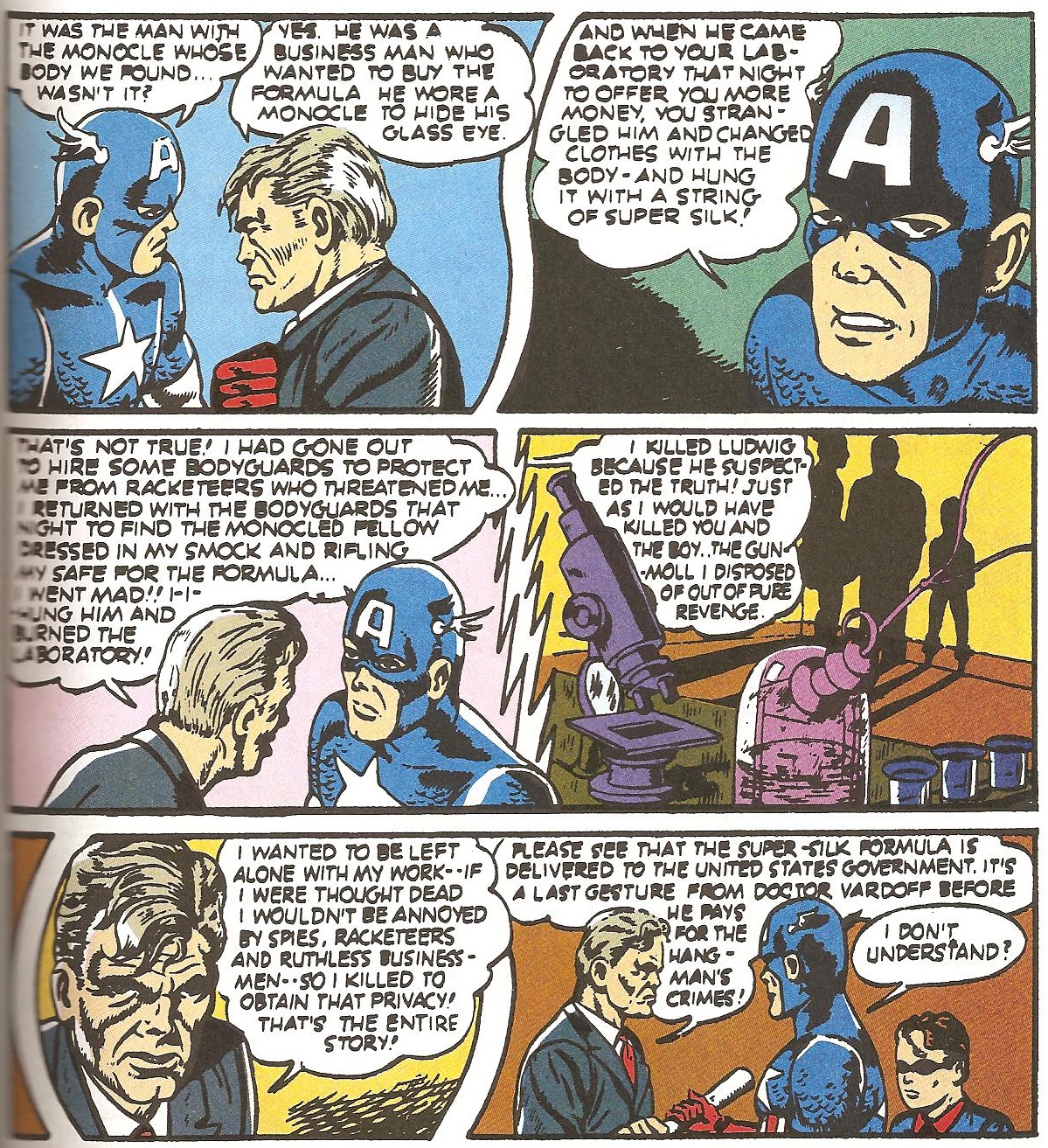
 Nevertheless, Vardoff still wants to see his formula used for the war effort, and solemnly gives it to Cap, and announces that he will make himself pay for his crimes….by spraying himself with an acid gun:
 Damn.
In a move prescient of 2008’s The Dark Knight, Cap, feeling pity for the scientist, decides to keep the Hangman’s identity a secret and allow people to believe Vardoff was a martyr.
The hero we deserve.

 This is one of Joe Simon & Jack Kirby’s best written (and grisliest) Cap stories. We have gruesome hangings, corpses set on fire in order to disfigure them, autopsies, glass eyeballs being flicked out of corpses,
crazed vigilantes who unintentionally echo the killer’s actions,
and an ending which shows that just because someone is a hero to the war effort doesn’t make them perfect, and the tragic villain kills himself by spraying off his own flesh with acid, with the hero then deciding to cover up his crimes.…whew. It’s as lurid as it got back then.
5) Fair is foul and foul is fair (“Case of the Black Witch” from Captain America Comics #8):
On one hand, this is a pretty generic mystery story that feels like an episode of Scooby Doo at times, with it’s gaping plot holes and bogus explanations for how the villain faked their supernatural abilities.
He'd have gotten away with it if wasn't for his meddling death

 On the other hand, Joe and Jack just draw the hell out of this story. It also makes use of a castle setting (which I assume is the same one from Hunchback, after all how many castles does Virginia have?) far better than Hunchback does. All the ghoulies and ghosties on display are a joy to behold, and a precursor to the various monsters that would pop up in Joe and Jack’s Black Magic series in the 50s. Seriously, I notice things in the splash page when re-reading this story that I’ve never noticed before (I particularly like the elf coming out of the pot and that lizard-like thingy). Not too scary or lurid, but it demonstrates that horror imagery was what that really captured S&K’s imagination.
 4) They’re dead! They’re all messed up… (“Case of the Hollow Men” from All-Winners Comics #1):
 Thanks to the efforts of one Mr. Kitty, this is probably the most well-known of Cap’s Golden Age stories, having zombies doesn’t hurt either considering the ridiculous level of  exposure that the damn things get these days. This one is interesting though, with it’s obvious class warfare subtext. We see the poor being manipulated (through the guise of charity) by an evil foreign power, and turned into literal mindless zombies, striking back at the industrial world through acts of sabotage.
 And I’ve said it before, but these are some damn creepy panels:

 3) Wait, he’s called the what now? (“Challenge of the Mad Torso” from Captain America Comics #28):
 Cap’s gruesome and horror-themed adventures didn’t stop when Simon and Kirby left, Cap would face a “vampire of doom” and a werewolf.
 That said, none of them could compete with this bad boy. They call him the Mad Torso.
I really could just leave you the name and that would be that, but no, we must go deeper!
So in this story, the Torso allies himself with the axis so he can have the resources for kidnapping American industrialists. He taunts Cap and Bucky into challenging him by sending them bizarre letters. After tracking the villain down, our heroes discover why he’s chosen his particular moniker:
 Oh, and he’s also pain incarnate:
 He also wants to perform brain transplants to create a master race:
 Cyborg mad scientist Nazis called the Mad Torso who try to create master races through brain transplants. They really don’t make ‘em like this anymore. Gotta wonder if this guy was an inspiration for Arnim Zola.
2) When sparks fly (“The Man who could not die” from Captain America Comics #9):
 While they may have been masters of the splash page, Simon & Kirby could also provide damn good moody introductions, case in point:
 That said, the splash page isn’t too shabby either:
An early rap album cover?

 This story obviously owes a debt to the “executed killer returns” subgenre of horror movies, which at this point consisted of the genre’s two best films: The Walking Dead (1936) and Man-Made Monster (1941), and which would come to a halt with 1989’s godawful Shocker. It’s still pretty good, and addresses the old urban legend about how if someone survives an execution, they can go free. In this case, no. Villain Nick Pinto gets sentenced to die again, but he doesn’t seem too angry about it. He’s confident he can come back again.
 Despite only being 13 pages, this story racks up some considerable tension in the way it contrasts Pinto’s good spirits with his impending execution. The final showdown between Cap and Pinto is a bit rushed, but it does end with two rather gruesome deaths for the villains:

HEY KIDS COMICS

1) The most f-ed up thing ever written by a human (“Case of the Black Talon” from Captain America Comics #9):
There’s lurid and warped, and then there’s this. This is Golden Age Timely/Marvel at it’s “purest”. This one has it all; gruesome torture and murder, an undercurrent of sexual sadism, horrifically racist implications and an overall atmosphere of morbidity. It’s awesome.
 Steve and Bucky attend an art show where they see a bizarre painting of a black, twisted hand (looks green to me), and while walking back to the base, they see the same hand reaching towards someone. Apparently this is enough to get them to switch to their superhero identities, and sure enough, they find someone dead; an artist in this case. The man's paintings are just as mutilated as his body. This has been happening for months now, so Cap and Bucky investigate.
 The prime suspect is Pascal Horta, a painter whose hand was crushed in an accident. However, Cap and Bucky arrive to find him hanged (Man, Simon and Kirby loved them some lynchings, didn’t they?). So he’s ruled out, right?
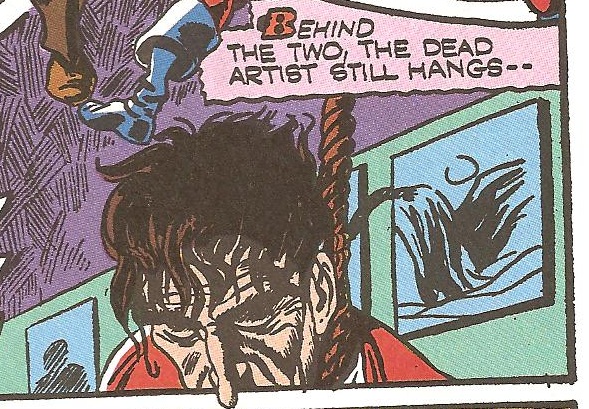
Nope, he just faked it.
Now that is creepy.

Pascal is indeed the one. You see; when his hand was crushed, he lost hope that he would ever paint again:
 However, his doctor decided to test a new procedure on him by transplanting another man’s hand onto his wrist. However, the only man willing to cooperate was Strangler Burns, a black serial killer slated for execution:
 Pascal reluctantly underwent the operation, and was elated at first to have regained his ability to paint, but then…
 Slowly, he grew to like his gruesome new paintings, and needed inspiration…
 While definitely inspired on some level by The Hands of Orlac (or more likely, the 1935 film Mad Love) in the “transplanted hand of a killer has a mind of it’s own" theme, there’s no denying the ghoulish inventiveness on display. Wanting artistic inspiration as a motive for murder? That’s definitely a new one, and quite sick when you think about it. The gruesome close-ups of the faces of Horta’s victims have a really creepy Faces of Death quality. Gotta wonder if this was any inspiration on Michael Powell’s film Peeping Tom.
 Thankfully, after almost 20 pages of unrelenting creepiness, the story at least ends on some good old fashioned hero vs. villain action to lighten the mood somewhat, even though Horta gets away. I don’t think any reader can deny how fucked up an experience the whole story is. That said, unpleasantness aside, it succeeds very well at keeping the reader in suspense, at making the villain both genuinely terrifying and sympathetic, and features some of Simon and Kirby’s best artwork. Also, it’s the first mention of Steve Roger’s appreciation for the arts, something that has become a lasting trait of his.
 If you’re going to read a screwed up Cap story from this era, make it this one. However, you might just want to take a shower after reading it.
~
 So as you can see, while Golden Age Cap might not have experienced the horrors of war, he certainly experienced a LOT of horrors!
 What was the reason for this? Tons of comic book heroes did nothing but fight the Nazis issue after issue, but Cap, whom everyone thinks of as comicdom’s #1 Nazi smasher, rarely did so. Why were most of his foes monsters? Lots of Golden Age heroes fought monstrous villains derived from horror literature and film, so Cap wasn’t exactly unique, especially, like I’ve said, at Timely. The explanation probably is something simple like “horror sells”, or Simon and Kirby’s love for pulp fiction and horror movies, or maybe just because monsters made for cool splash pages, but maybe it was something deeper.
 Maybe it was because, for the past few decades after WWI, Europe had been romanticized as a genteel, fairy tale-like place. “The old country”. However, with war breaking out, no one could afford to see it as that anymore. It was a land filled with strife, poverty, and genocide. It was like all the bad things from Europe’s medieval past were coming back; ruthless dictators, poverty, superstition, religious oppression. Only this time, it threatened to come to America. The “past” (Europe) was literally coming back to haunt us.
 Thus, just as how man has symbolically depicted his problems since time immemorial as monsters and demons, perhaps that is why Cap’s foes during this era consisted mainly of gothic monsters, fairy tale madmen (in the Bluebeard vein), seemingly medieval hangmen, witches, the walking dead, etc. We didn’t know if we could beat the Nazis, but these monsters representing European folklore could be slain. And in the case of the villains inspired by modern, American films and literature, hey why not keep up with the times?
Nah, it probably was just because monsters made for cool splash pages.
‘Keep ‘em flyin’.

Friday, March 23, 2012

Golden Age of Marvel Comics Vol.2 review:


 When I reviewed Golden Age of Marvel Comics Vol. 1 a short while back, my biggest complaint was how the stories reprinted therein weren’t bad so much as already easily accessible for hardcore Golden Age enthusiasts (and really, who else is going to be in a race to snatch this stuff up?). At the same time, the stories were baffling for the uninitiated since there were no origin stories or even “exemplary” stories chosen for the characters (I always try and review things objectively, as if I weren’t a comics fan). All in all, it hardly gave a good impression of Marvel’s Timely/Atlas era.
 So here we have Golden Age of Marvel Comics Vol. 2. Not only does this correct all of the faults of the first volume by offering up more obscure stories, showcasing origins and rarities (like the one-shot Red Raven Comics #1), but it shows that Timely could easily hold its own when you compare “era” anthologies. This volume offers just as much fun as anything in DC’s The Greatest Golden Age Stories Ever Told. Also, and I’ve mentioned this before, but for years this volume (which is still out of print) was impossible for me to find online (even on the Boob-haven itself; Amazon.com) or in comics stores. When I finally snagged a copy in 2008; it was one of the few comics-related acquisitions I’ve obtained that I felt genuinely proud of, and considering all the hype I had built up for it, I wasn’t disappointed in the least.
 But enough yammering about me, it’s time to yammer about the stories:
Human Torch in “The Human Torch” from Marvel Comics #1: Kids in 1939 sure got their money’s worth when buying the first issue of Marvel back in 1939 (it sold so well that it was reprinted the next month), not only is the Sub-Mariner origin story a classic, the Human Torch’s debut isn’t bad either. It reflects Timely’s pulp/horror sensibility quite well.
 A scientist named Horton creates an artificial man who bursts into flame when exposed to open air, which he dubs “The Human Torch”. The press and a local “Scientist’s guild” (was that a real thing?) unite to force Horton into destroying his creation. Instead, Horton has the Torch buried alive in a steel tube and encased in concrete. However, some oxygen leaks in and the Torch is released, he runs around the city, unintentionally spreading death in his wake. The Torch jumps into a pool owned by a crime boss/mad scientist named Sardo, who decides to use our hero for an arson scheme. Things aren’t going to go well for him…
 If Sub-Mariner was inspired by Greek mythology and H.P. Lovecraft’s horror stories about race-mixing and sea monsters, then The Human Torch was an answer to Universal’s Frankenstein films, specifically the last two that had come out (Bride of and Son of) in that they focus just as much on the warring attempts by two factions (Horton & the Police VS Sardo= Frankenstein family VS Pretorious in Bride and Ygor in Son) to control the Monster/The Torch than on the artificial monster himself. Horton’s constant flip-flopping from a father figure to a heartless twit is interesting, and it’s cool how Sardo, who seems at first glance to be a typical mob boss, is actually a methodical scientist who is apparently quite wealthy already. He would have made an interesting recurring foe.
 The Torch himself is rather interestingly characterized as well; he can speak in full sentences and is apparently well-educated enough to understand what a ‘racketeer’ is, but he also displays childish qualities; being entertained by the sound of a fireman’s bell, being tickled when he’s sprayed with water, and taking a sadistic, but childish glee in burning Sardo’s house down. It’s definitely one of the most interesting depictions of an artificially created being that I’ve seen in comics. I also like how writer/artist Carl Burgos doesn’t shy away from depicting how (unintentionally) destructive the Torch is to civilians.
 This story has some plot holes (how did Sardo intend to recapture the Torch after his first arson scheme without a glass tube?) and some silly moments (a judge just lets the Torch off with a laugh after all of the destruction he’s caused), but all in all it holds up rather well. Carl Burgos’s art is crude even by Golden Age standards, but he’s a decent storyteller, which is what should count in the end. Surprisingly intelligent and entertaining. 4.5/5.
 The Fiery Mask in “The Fantastic Thriller of the Walking Corpses” from Daring Mystery #1: This was Joe Simon’s first superhero story, and as I’ve said before, it’s awesome. Zombies. Giant vultures. Giant green-skinned mad scientists. Death rays. The lamest wisecrack in comics history. A hero who defeats a horde of giant vultures by blowing a gust of wind at them with his breath. What more could you ask for? 5/5.
 The Red Raven in “The Red Raven” from Red Raven Comics #1: Perhaps it’s because he was the first Marvel hero to get his own title (even though this was his first and last appearance in this era), but something about The Red Raven has led countless writers to revive him. Here’s where the “legend” begins:
 A jumbo jet crashes during a storm, but it lands on a floating island in the sky inhabited by bird people. The king of the bird people decides to raise the only survivor, a young child, and he grows into a strong young man. The man goes to America, seeks employment, but gets into a brawl at an unemployment line, which somehow catches the attention of a criminal mastermind named Zeelmo, who has driven the country into poverty by stealing gold, who then tries to recruit him. Our hero gets offended by Zeelmo, and instead attacks him. Zeelmo then has our hero dropped into a room which spews out “aging gas”. Our hero switches to the identity of The Red Raven, escapes (somehow unaffected) and kills Zeelmo. Zeelmo’s successor (who has the annoying habit of saying “Ah Ha Ha” all the time) then hunts him down, but the Red Raven goes back to his island, where he is given a device that can seek out and summon gold. Red Raven then poses as a scientist in order to attract the attention of Zeelmo’s successors. Then he uses the device the bird people gave him to summon the gold from it’s vaults and drown the villains.
 Clearly, this story is an elaborate commentary by Joe Simon about the great depression: Red Raven represents the proletariat. Zeelmo is meant to represent the evil bourgeoisie bankers and businessmen who have drained the economy, forced people out of jobs and pitted them against each other in the quest for work (Red Raven’s fight with the homeless man), and has caused the premature aging of a whole generation (symbolically represented with his age gas). However, even though Red Raven kills Zeelmo, the villain’s organization continues on with a new leader, symbolically representing that no matter how many evil businessmen we expose, someone will always take their place. In the end, the villains are buried alive by their own obsession; gold, just as how the pursuit of money has ruined so many people in real life.
Scrooge McDuck never has this problem

 …Or maybe it’s just a silly comic book story that I’m having fun with by reading things into it because I’m drunk. Still, despite the gaping holes in the plot (If Red Raven has so much trouble finding employment, how does he set himself up overnight as a respected scientist? And how/why does the Age Gas wear off?), it’s fun, and Louis Cazeneuve’s art looks an awful lot like that of a young Jack Kirby. 3.5/5.
 The Vision in “Enter: The Vision” from Marvel Mystery Comics #13: A scientist named Enoch Mason creates a “dimension smasher” in order to find a way into the spirit world, which he believes is simply another dimension. Unfortunately, he gets held up in the middle of his experiment by some mobsters working for a loan shark called “Brains” Borelli (one of the greatest mobster names I’ve ever read in comics). Simple greed over unpaid loans would have sufficed for Borelli’s motivation, but instead Borelli is given another motivation which, well, just read it:
                Man, a world where big, dumb guys get picked on by nerds? Sign me up.
Borelli’s goons take Mason and the other scientists hostage, but enough of a link has been established with the spirit world that the smoke from a thug’s cigarette summons up Aarkus the Vision, who promptly freezes a thug to death by touching him. Then, in a very Spectre-like scene, our hero kills another thug simply by growing to giant size and staring at him. The rest of the story involves Aarkus taking out the rest of the mob, albeit in a less dramatic (and even humorous) fashion.
 Kirby is obviously going for a “horror” feel here, but his overuse of cross-hatching simply makes the art look dirty, and some of the more humorous moments kill the atmosphere, there’s also a weak attempt to set The Vision up in a secret identity. Nevertheless, the whole idea of an otherworldly being that appears out of nowhere to aid the innocent if there’s smoke in the air is just awesome. This story also establishes that The Vision only appears in his true form to those who are about to die, which is a neat idea, but was dropped after this story. Too bad.
 I also have to wonder though if the whole idea of “scientist summons bald, shape-shifting, green-skinned alien being with large head to earth and leaves him semi-trapped” inspired DC’s Martian Manhunter, whose weakness, oddly enough, was smoke and fire. One thing is certain though; Joe Simon & Jack Kirby must have liked the idea of setting up a superhero origin in a laboratory where an experiment multiple people are witnessing gets sabotaged, as it would be the origin for a more enduring character; some captain guy… 4/5.
 Captain America and Bucky in “Case No.1: Meet Captain America” from Captain America Comics #1: Well, whaddya know? It’s that very captain guy I was thinking about! Do I really need to summarize this one up? I think I’ll just comment on what sticks out to me besides the obvious and tired jokes about how slapdash Bucky’s identity is, etc.:
 -This universe’s version of FDR must not read the papers much:
-What’d I tell you? Same set-up as the first Vision story:
-The name “Steve Rogers” is not used during the origin sequence. For all we know, “Steve Rogers” could be meant to be interpreted as a code name.
 This story is more interesting during the set-up (the curio shop scene is nice and moody) and the origin sequence than it is when Cap actually shows up in costume, and because he doesn’t speak much or seem to have any kind of background, we don’t really get to know him. Part of me would like to see this lack of characterization as clever writing; making him the faceless embodiment of America as a whole and not an individual, but more likely than not it was because of the page count. I’m glad they included the origin, but there are tons of great Cap stories from this era they could have gone with instead. Still, it’s much better crafted than almost anything else at the time, the artwork is superb in most panels, and all in all, it’s hard to fault a classic piece of Americana like this. 3.5/5.
 Hurricane in “Murder Ltd.” From Captain America Comics #1: Whoooeee. This is more fun than the actual Cap story from that first issue. The Hurricane is actually the Greek god Mercury (Or is he? He is described as being the son of Thor!), who battles the forces of evil here on earth, his archenemy being Pluto, god of evil (portrayed as a typical devil character here). Our hero seeks out a mobster named “Piggy” Perroni and tries to infiltrate his mob so he can be led to Pluto, who has been posing as a rich socialite named Sayden (say it fast). He does away with Perroni anyway, simply because he insults him, then he crashes one of Pluto’s costume parties.
 This story is basically plotless apart from the overall goal of Hurricane fighting Pluto, but it’s so full of well-timed comedy (particularly the scenes with two disbelieving cops) and surreal bits (Hurricane takes the wings from his costume that enable him to fly and places them on the side of a taxi to make it go faster) that I just fell in love with it. I really like the “Masque of the Red Death” ambience on display when Hurricane crashes the party, and while Hurricane is portrayed as a hero, the story still shows him to be vain and mischievous, just like the actual Greek gods. All in all, it reminds me very much of Thorne Smith’s book Night Life of the Gods, which is likely what inspired this whole set up.
 Or was it? In Red Raven Comics a few months earlier, Kirby had written and drawn a story called “Mercury in the 20th century” that utilized the same concept; Mercury battling a Satan-like Pluto on earth (I have fond memories of reading that story’s reprint in Marvel Super Heroes #14). Of course, that story would have been impossible to maintain as a continuing series, since Pluto is revealed to be Hitler AND Mercury defeats him and ends the war in it (something which definitely wasn’t happening in real life), so I can see why they changed the character’s name and toned down the scope of the storyline. It’s still clear that the whole idea of mythological figures in the present day appealed to Kirby, as Thor later showed.
 Also, “Piggy Perroni” is my new favorite name for a comic book mob boss. You can have your Falcones, Fisks, Maronis, Trasks and Whales; all of ‘em pale in comparison to the Pig. Hey, Marvel! I want a 12 issue mini-series focusing on a gang war between Piggy Perroni and Brains Borelli! 5/5.
Tuk the Caveboy in “Stories from the Dark Ages” from Captain America Comics #1: A young boy, one of the only humans alive in a world drawn by Jack Kirby, embarks on a great quest, crossing paths with intelligent animals and shaggy beast-men.
 No, this isn’t Kamandi, this is Tuk the Caveboy. On one hand, I was glad to see a non-superhero story included in here, on the other, I really don’t care for prehistoric adventures. Nevertheless, I read on, and found this quite enjoyable. An old, one-eyed Neanderthal named Ak lays dying, but he imparts onto his adopted human son, a young boy named Tuk, that he comes from a race of humans who were banished from the land of Attilan (which I’d like to think is the same place from the Inhumans stories from Fantastic Four). Tuk ventures forth, and befriends another human named Tanir. And then the story ends.
 Damn! Right when it was getting interesting! I actually regret selling my GA Captain America Masterworks edition now, because I want to read more of these. 4/5.
Namor the Sub-Mariner in “The Sub-Mariner Smashes a Nazi uprising” from Marvel Mystery Comics #26: The alien queen Jarna (who can breathe underwater but looks human), an old enemy of Namor’s, tricks him into falling into the hands of Nazis who have set up an underwater base.
 Plot wise, that’s it really. After that set-up, the rest of the story is nothing but violence, name-calling, woman-beating, and characters screwing each other over and switching allegiances at the drop of a hat. Stan Lee would later return Namor to the regal speaking style he displayed in his first appearance, and logically, that is how Namor should talk. Still, as weird as it is seeing Namor using American slang in these stories, it just somehow works. Besides, Everett still communicates Namor’s arrogance to the reader perfectly. You wouldn’t mistake him for any other comic book hero.
 Anyway, you just can’t hate a story where the hero actually falls for the old “look behind you” ruse and tosses around insults like “You dang dummy!” and “German jerks!”. At one point, the dialogue is composed of nothing but insults for two whole pages. As usual, Everett’s art shines, the elegant, fine-lined art contrasting hilariously with the grade school dialogue. I could read this all day. 5/5.
  The Whizzer in “Origin of the Whizzer” from USA Comics #1: Yes folks, this is the infamous Flash rip-off character that got his power from mongoose blood. I just….just…yeah. Even if the story sucked, that single fact automatically propels this story to the top of the heap.
 But you know what? It’s actually a fairly entertaining, if standard “avenge my father” story, although here it’s slightly more interesting because the Whizzer’s father was framed for murder by mobsters and then died on his own. Al Avison’s art is well above average for the time. I can see why he would replace Simon & Kirby on Captain America. The art reproduction on this story is a bit hazy, but not bad.
 Still, regardless of any aesthetic merits….mongoose blood.
Even the mongoose is dumbfounded

 The funniest part of all about this? The whole “mongoose blood powers” thing wasn’t even original! It had actually been done in a pulp story (which sadly, hasn’t been reprinted) a few years earlier. I don’t know whether to laugh or to cry over the fact that some comic book writer apparently thought that that was a good enough idea to rip off. 3.5/5.
 Namor the Sub-Mariner in “The Fox’s Smuggling Racket” from Marvel Mystery Comics #27: Namor decides to go to Washington State to see what mischief he can get into (seriously, that’s his motive) and finds out that local “brushmen” (people who work in the fur trade) have been out of a job because someone has been stealing fur cargoes so they can sell them tax free. Namor investigates and finds out that it’s the work of a gangster named the Fox (whose appearance is indeed vulpine). Mayhem ensues, and as usual Everett’s artwork shines.
 This story is a bit of a precursor to the 1950’s Sub-Mariner stories in that Namor is acting as a detective and a friend of us surface people, and is also shown to care about the little guy. This story also distinguishes itself from other fur hijacking stories (my god, fur trading and phony psychics must have been the boom industries of depression-era America) in that it has a character (the Fox) who functions as a sort of supervillain and finds a way to make use of its hero’s powers (the Fox is using miniature submarines and missiles).
 What’s most interesting is Namor’s characterization. He may be a friend to humans (at least, the allied ones), but it’s still clear that he partakes in these missions simply because of an inherent love of violence. When he told Betty Dean in Marvel Mystery Comics #3 that he didn’t care whose side he was on, he meant it. In the book Men of Tomorrow: Geeks, Gangsters and the Birth of the Comic Book (a fascinating, if often condescending book), writer Gerard Jones described these early Sub-Mariner stories as “a romance of superhuman violence without good guys or hope of a happy ending, a supreme Irish barroom fantasy”. Couldn’t have said it better myself. 5/5.
 The Human Torch & Toro in “Carnival of Fiends” from All-Winner’s Comics #1: The Chinatown committee decides to throw a festival to raise funds for China, but Japanese agents headed by a guy with a Hitler mustache named Matzu sneak in and try to sabotage it. The Human Torch and Toro investigate, and narrowly avoid getting hypnotized and made into slaves.
 Unremarkable, but the art is so rushed that you can’t really say that the depictions of the Asians are offensive since their faces are given so little detail. I also love how, of the two Human Torch stories featured in these volumes that have Toro in them, both have sequences where Toro gets hypnotized by the villains and the Torch has to punch him out to bring him to his senses. 2.5/5.
 Captain America & Bucky in “Case of the Hollow Men” from All-Winner’s Comics #1: One of the most famous non-Red Skull Cap stories from the Simon & Kirby run, this one has everything: Nazis, sabotage, a red-hooded super villain called “The Lord of Death”, indestructible hobo zombies, and ends with Bucky giving Hitler a raspberry over the phone. There are plenty of jokes I could have made about this story, but this guy already beat me to it. I also could have read something into the fact that all of the victims of the villain in this story are homeless people (a similarity this story shares with the Fiery Mask story), but as far as reading class conflict subtexts into 1940s comic book stories about zombies go, I already did enough of that to last me a lifetime this Halloween.
Oh yeah, during my quest to hunt down a copy of this volume, I managed to locate a “Collector’s Edition” special devoted to Cap from 1995, which featured a reprint of this story (along with an in-depth look at Greg Theakston’s restoration process for old comics, an interview with Joe Simon and one of the few genuinely funny “Let’s imagine if this superhero was real” parodies that I’ve ever come across). The work there was fine, but I have to admit I prefer the darker color scheme used in this printing. 5/5.
 The Black Marvel in “The Order of the Hood” from All-Winner’s Comics #1: Man, All-Winner’s Comics #1 and Cap #1 are for this volume what Marvel Mystery Comics #42 was to the previous. Still, this is a fun story. A group of criminals called “The Order of the Hood” go on a (surprisingly small-scale) crime spree throughout the country, apparently driving from Colorado to Los Angeles overnight. Only Dan Lyons aka The Black Marvel can stop them.
 *Whew* Two stories featuring villains in red hooded robes in a row. I’m going to make a contribution to Marvel continuity and assume that the Lord of Death from the Captain America story was a rogue member of this organization. Like I said, the villains in this story seem surprisingly small scale (they intend to get the government to pay them a million dollar a year in order to make them stop, but they don’t seem to be much more than a bunch of costumed bank robbers), but this story also has what may be the first moment in comic book history where the villains plot to execute the hero on live TV (well, what passed for TV in the 40s).
  A comic book milestone, perhaps? 3.5/5.
 The Vision in “Cult of the Shark God” from Marvel Mystery Comics #23: One of my primary reasons for pursuing this volume was just so I could read this story. I first read of it in The Jack Kirby Collector #13 back in the 90s, and let me tell you, stories which feature evil sharks with Hitler-haircuts are a surefire way to make me want something and pursue it obsessively. This one didn’t disappoint.
 “The ominous, rhythmic, booming tom-toms echo in the jungle night, as the weird rites of the Zambiji tribe are held in the light of a full moon” begins our tale, as some natives carry off one of their own, who is bound hand and foot, to a lagoon. The poor guy is sacrificed to a giant walking shark with arms and legs and hair named Kai-Mak. Soon an elderly explorer and his daughter fall into the cult’s hands and are about to be sacrificed, but the smoke from the ceremony summons Aarkus (who is always willing to help elderly scientists and their daughters, it seems) and he does battle with Kai-Mak.
 This one is just too good to last. Sure it’s silly, the natives never receive any punishment, and Kai-Mak goes down too easily, but it works. Moody, exciting and featuring a kickass villain (inspired by A.E Van Vogt’s The Sea Thing, perhaps?), this is the kind of thing comic books were made for. Now that Aarkus is back in the Marvel U, I want to see Kai-Mak brought back for a re-match. Maybe Namor and Tiger Shark could join in. 5/5.
 The Fin in “The Magic Cutlass” from Comedy Comics #9: The aquatic awesomeness continues with this yarn by Bill Everett. Lt. Peter Noble, the superhero called the Fin, finds a magic cutlass that’s impervious to harm, gets kidnapped by a press gang working for the Nazis, and mayhem ensues.
 As with most Everett stories there’s little plot to speak of, but the art, the action and the far from savory protagonist makes it wildly entertaining. Actually, I take that part about the “unsavory protagonist’ back, because the Fin seems like a nice enough guy, with far more of a sense of humor and righteousness than Namor. He still has badass moments like this, however:
Damn.

 Quite a lot for “Comedy” comics, huh? Re-reading this story, I find that I like the Fin a lot. Too bad he was never a big hit. This strip is a fine combination of the super hero, swashbuckler and sword and sorcery genres, and really has potential. 4/5.
 Citizen V in “V Battalion” from Comedy Comics #9: Citizen V, a superhero who operates as a resistance fighter overseas, leads a rebellion, but gets captured by the Nazis. While he can escape easily, he soon finds that if he does, the Nazis have dire plans for their prisoners…
 A pretty generic “hero fights the Nazis” story, but I do love the idea of a superhero who acts as a figurehead for an entire revolution, more of a symbol than a man. He’s sort of like a war-time Robin Hood. Also, as is usual with most second-rate patriotic superheroes, he has far more in common with modern depictions of Captain America than modern Cap has with his Golden Age counterpart.
 It’s an interesting story in some ways, because this is basically a war story that only qualifies as a superhero story because of the hero’s costume, but it goes on a little too long. 3/5.
 So while this volume may not go out with a bang exactly, it sure as hell made for a fun ride. This is what I think of when I think of the Golden Age; ruthless heroes who were men’s men, wigged out plots, stream of consciousness pacing, Nazi-bashing, lingering depression-era angst, and an ambience of surrealism and novelty that modern comics just can’t generate. While there are more characters and stories I’d have liked to have seen featured (the Black Widow, the Challenger, Blue Blaze), I really can’t complain. If the first volume had cut some of the crap out, and been combined with the stories in this volume, we would have one huge volume of awesome. Hell, I wish Marvel had still cranked out a few more of these (like say, a volume completely devoted to the 50s hero revival, or the various female characters like Sun Girl, Namora, Miss America), but they didn’t. Some things are too good to last, I guess.
 As a whole, I can’t recommend this volume enough. 5/5. Worth the hunt.
 Oh, by the way, did I mention this book has an introduction by the Hammer-slammer himself, Mickey Spillane? You know you want this.