I discuss Golden Age comics here an awful lot, but that’s simply because the era is my unabashed favorite. Oh don’t get me wrong, I know the vast majority of the stuff put out then was crudely drawn and written, racially insensitive, sexist, jingoistic and derivative as all hell (Emphasis on derivative), but I can look past all of that for the sheer enthusiasm bursting through. Maybe it’s because a lot of modern comics do their best to imitate a pulp/1940 ambience, while Golden Age comics were the real thing. Or maybe it’s just because I get my jollies from seeing all the lurid trash that was marketed to kids then.
Tonight however, it’s time to hurt the one I love. Get ready to delve headfirst into some of the most shamelessly derivative comics the 1940s had to offer! No Eisner or Cole caliber stuff here folks. No, we’re taking a trip to the rip-off factory.
Being a journeyman comic book writer during the 40s must have been one of the greatest Phone-it-in jobs of the century. All you’d really have to do was draw strips of paper out of a hat marked ‘Gangsters” or “Nazis”, and you’d have a villain for your story. Then you’d just have to hammer out a script filled with as many expository panels and wisecracks as possible, end with a speech about how Crime Does Not Pay or how great America is, send it off to your editor, collect your check, and then go off on the biggest bender your rations card would allow. Rinse and repeat.
But what to do if your editor was tired of gangsters and Nazis and wanted a super-villain? Well, you’d have many options:
You could just make up a generic villain based off of some public domain story or fairy tale, but spice it up by having your artist “homage” the work of artists from rival companies:
Irv Novick does his best Simon & Kirby impression
Or you could recycle the same villain that you already used in a different series that you worked on; you’d just have to change the name and costume this time….and nothing else:
From Pep Comics #32 (1942)
From Black Hood Comics #14 (1945)
Or you could just copy villains from better-selling comics. And that’s what we’re here to discuss. Since my villain-centric posts seem to get the most views, here’s proof that Batman’s rogues gallery was one of his most popular and imitable features even during the 40s. However, while some of these copyright infringing fiends obviously wouldn’t have been created without the influence of Batman’s rogues, some of these apparent “Rip-offs” aren’t as clear cut as they first appear to be. In fact, some of these characters may even have inspired certain elements that have become more popularly associated with Batman’s villains. Did they? It’s all up to you to decide, folks.
I may as well start with the imitators of Batman’s most famous rogue; the Joker. For anyone out there who frequented the hellhole which was IMDb’s Dark Knight board back in 2008, you may recall the infamous “So teh Jocker was dead? ” thread, which briefly led to “teh Jocker” becoming the board’s nickname for people doing bad Joker impressions. Thus, I will refer to these Joker imitators as “Jockers”. But were these ‘true’ Jockers or just variations on a theme?
The most notable (And longest lasting) of the Golden Age Jockers was Magno the Magnetic Man and his sidekick Davey’s archenemy the Clown, who made his debut in Super-Mystery Comics #5 in December 1940, courtesy of Ace Comics (A publisher we won’t be seeing the last from). Magno and Davey themselves were pretty typical heroes for the time, with Magno being Ace’s Superman equivalent and Davey being a fairly typical kid sidekick. But hey, it’s the villain who I’m here to discuss!
Since comics were usually on the stands two-three months in advance, this means that Super-Mystery #5 was probably available sometime in September. The Joker’s debut in Batman #1 was in the spring 1940 issue, and he had returned in the next. So yeah, this means that the Joker had only appeared in two comics at this point (Without being on a single cover) and was already being imitated.
At first glance, the Clown doesn’t really seem like much of a Jocker, just a guy in a clown suit.
Clown would later reform and give a young Glen Milstead makeup tips
Clown’s status would also vary from story to story as to whether he was a spy or an eccentric criminal mastermind. So how much of a Jocker was he? Well, let’s look back at his first appearance…
Although given Caucasian skin in almost all of his stories (With one exception), the Clown was depicted with white skin and red lips on the cover of SM#5, and he was drawn as a lot ganglier than he would later be (Some later stories made him look downright fat):
It was clear that, regardless of his differences from the Joker, the editors were more concerned with trying to play up his similarities. The covers of Super Mystery would advertise the hell out of the Clown, with the villain actually making the cover five times in a row after his debut! The Clown also had a laboratory/hideout hidden underneath a cemetery:
I love how he apparently just “purchased” it. Also, you have to giggle at how the artist went out of his way to make sure the henchwoman’s ass wasn’t cut off by the panel-border. Even in the 40s they had shameless fan service!
Anyway, the tomb/laboratory seems negligible at first, more like a reference to The Spirit than anything else, until you remember who also had a laboratory/hideout underneath a cemetery in his early appearances:
They even copied the scene where Batman knocks Joker into some explosive chemicals:
However, after that scene, Batman gave chase to the Joker for several more pages of mayhem, whereas in the Clown’s debut, that was the apparent end of the story.
That said, one certainly couldn’t fault the Clown’s debut when it came to the mayhem department!
The story began with Davey checking out a chemistry book from the public library:
As a former librarian, I have to say I’ve seen things like this happen quite often.
However, they never quite escalated into, well, this:
Army of Darkness was right, chemistry textbooks can teach you to make super-weapons!
Ah, redundant dialogue, blatantly phallic symbolism, and wanton murder of authority figures. Remember kids, this is from when comics were at their most innocent!
Davey ran off and contacted Magno, who, bless his heart, thought all that the Clown needed after brutally murdering a public servant was a little heart-to-heart chat:
Oh yeah, that'll work!
Well, at least, that was Magno’s original intention, because he then caught the Clown burning an American flag for shits and giggles. All bets were off after that. No one burns an American flag in front of a Golden Age superhero and gets treated with kid gloves.
Also, he could fly now too because of a heretofore unmentioned solvent, because comics.
After narrowly escaping the heroes, the Clown then embarked on his master plan: Killing a bunch of civilians in a subway terminal for no real reason at all:
I’m not going to spoil the rest of the story; you can read it all over at the Digital Comics Museum. I’ll just say that the conclusion quite literally involved the kitchen sink. None of the Clown’s return appearances quite measured up to his debut in terms of entertainment value, most were just typical robbery schemes, although he did occasionally team up with other villains like Zora and the Torcher (Neither of whom had appeared previously, to the best of my knowledge). The writers didn’t even try to hide his Joker similarities as time went on. In one story, he not only appeared in whiteface, but used deadly laughing gas:
In another story, the Clown made his victims “smile” by scarring them, eerily foreshadowing 2008’s The Dark Knight:
It’s interesting to note that, whereas in his early appearances where he was a killer, the Joker still mostly targeted specific victims and displayed little humor or sadism, the Clown not only displayed a wacky sense of humor from the beginning, but also engaged in the kind of mass murder of civilians and random mayhem that has come to characterize post-Crisis Joker.
Bulls-Eye's first appearance from World's Finest #24 (1946)
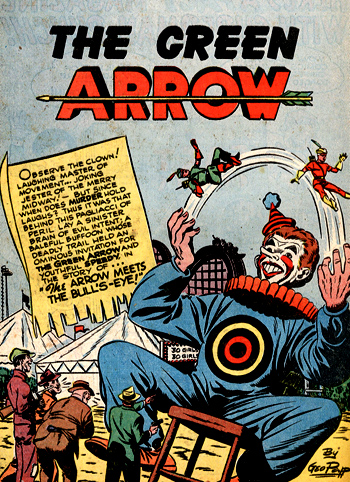
Many years before he became the obnoxious limousine liberal we all know and hate, Oliver Queen was basically Batman with a Robin Hood motif. He had a sidekick, car, plane, signal and utility belt like Batman did, so it made sense that he would also have his own clown-inspired nemesis.
Leapo was an imprisoned thief who felt he had been “targeted” by the law, so after he escaped from prison he became obsessed with targets, and hid out at a carnival where he performed as a ‘living target”, moving so swiftly that none of the customers could ever hit him. By day he was a performer, but at night he sought revenge against the judge and DA who had convicted him, much like the Joker did in his first appearance.
You can pretty much guess why he was such a thematically fitting foe for Green Arrow, and he would inexplicably keep the clown guise even after his first scheme was foiled. He also kept using the “Hit the Bulls-Eye! Only 10 cents!” line, like it was his catchphrase:
Naturally, he also plotted his crimes by aiming at a dart board:
I’ll admit Bulls-Eye is silly and derivative, but at least his weird obsession with targets made him different enough to be fun. I don’t really know if he should make a comeback, but I do have to say I like him better than GA’s current archenemy; Merlyn (Seriously, for a ‘big bad’, how many of Green Arrow’s own comics had Merlyn actually appeared in prior to the late 2000s?).
One Golden Age clown villain however, was recently brought back by DC. This fellow was also simply called “The Clown”. The Clown made his debut in MLJ’s Special Comics #1, a series starring a violent hero known as The Hangman (Basically Ditko’s Mr. A; 40’s style), and which would in fact be retitled Hangman Comics with the next issue. This Clown was a circus performer named Charles who was in love with a society girl named Linda:
Charles pretended to be a stock-broker, thinking it would sound more dignified, but Linda (Who was cheating on Charles behind his back) already knew, and set him up to be humiliated:
Poor Charles didn’t take it too well, resulting in the greatest Golden Age freak-out ever:
Fun fact: MLJ comics is the company that would later publish Archie
He then gets into Linda’s purse to get out her makeup and lipstick. The result:
Charles clearly failed makeup lessons at clown U
Later, Linda’s friend Thelma Gordon (Girlfriend of Bob Dickering aka The Hangman, and the fact that Dickering and Thelma hung out with folks like Linda pretty much sums up what kind of people they were) stumbled upon the bodies, and contacted the Hangman.
By the time the Hangman came for him, Charles was already quite gone:
He didn’t put up much of a fight, and after several pages of running around:
So yeah, the Clown wasn’t really a full-fledged super-villain so much as just a one-off madman. Yet, for some reason, in DC’s 2009 revival of The Hangman (DC had acquired the rights to the MLJ heroes in the 90s), John Rozum gave him a cameo: All that said, I don’t really consider this character a Jocker; he’s obviously just a variation on the Pagliacci “scorned clown” theme (Will Eisner also did a Pagliacci riff for The Spirit). The folks on Pappy’s Golden Age blogzine have also compared the story to Lon Chaney Sr’s various clown films. They may just be right, since in Pep Comics #44 the Hangman fought a villain named the Snail in a story that was basically a shout-out to the circus films of Lon Chaney and Tod Browning. Expect more on The Snail (And the Hangman) when October rolls around. Still, regardless of his inspirations, I thought I’d give this character a mention, since hey; he’s a killer clown who disfigures his victims by making them ‘smile’, plus he’s appeared in the modern age (If only for a cameo).
There’s no denying that the clown prince of crime inspired this next villain on our list though, who was also called….the clown prince of crime:
LAWDY!
This fellow debuted in the May 1949 issue of Doll-Man #23, courtesy of Quality Comics.
That said, what’s in a name? So what if The Minstrel was called the clown prince of crime? How similar was he in other ways to the Joker? Well….
I could just post the splash page, really, and that’s all you’d need to know to answer your questions. This guy was a Jocker with a capital “J”.
I guess you could argue to some extent that he was also inspired by musical villains like Flash’s Fiddler and Captain Marvel’s Mr. Banjo, but seriously, just look at that face:
He also tried to kill Doll-Man by tying him to the gong of a bell. Sure it fits the musical motif, but if Joker didn’t actually do something similar to this at some point in the Sprang era, then you can bet he will sometime in the future, whenever someone does another Brave and the Bold-style homage to old Batman comics:
So far, it seems like most of this post has disproportionately featured Joker copycats, but that’s simply because he was the most popular Batman villain, thus the most widely imitated. Still, while there were plenty of clown villains (Most of whom really don’t count, like Green Lantern’s Harlequin and Fool), as well as some villains with vague similarities that I considered but ruled out (Like The Spirit’s Mr. Dusk and Mr. Midnight, Human Torch’s Hyena, Mr. Scarlet’s Black Clown and Hangman’s Jackal), I’d say it’s time now to move on. Now for the Catwoman wannabes!
It should be pointed out that cats were a popular motif during the era, for heroes as well as villains. Heroes and heroines in feline garb included Miss Fury (Who was very successful back then, having her own newspaper strip), the Lynx, Red Panther, two different heroes called Cat-Man (One of whom was not only created by Miss Fury creator Tarpe Mills, but actually pre-dated Madam Fatal as comic’s first cross-dressing hero, more on this character later), and probably the two most well-known; DC’s Wildcat and Harvey Comic’s Black Cat.
Possibly as a result of all these cat-inspired characters in comics, or possibly because superstition holds cats to be satanic creatures in opposition to Heaven, that most angelic of superheroes; Timely/Marvel Comic’s The Angel, developed an affinity for fighting cat-inspired villains. The most infamous of these was the Armless Tiger Man, who might possibly be the greatest fictional character ever created in the medium of comics:
Actually, make that greatest fictional character period.
However, even though Armless Tiger Man has practically become a meme (Well, as much as one-shot Golden Age villains of obscure heroes can be), Angel’s most important feline adversary (And the most relevant to our interests) was the Cat’s Paw; who starred in a 1941 three parter running from Marvel Mystery Comics #18-20. In contrast to Catwoman, Cat’s Paw was rather ambitious; she was the leader of a gang that killed people with poison darts, and her plan was to seduce and kill off various heads of industry so that the men who hired her could take over. She wore her costume both in combat AND at society costume balls.
But how similar was she to Catwoman? Well…
She wore a cat mask (Very similar to Mazuchelli’s, in fact):
Used a whip:
And engaged in rampant Foe-Yay with the hero:
Sadly, Cat’s Paw killed herself by jumping off a roof:
Oops, I’m sorry. That last panel? That isn’t Cat’s Paw. That’s Catwoman. No seriously, that’s Catwoman.
Not our Catwoman though:
Yeah, they didn’t even try to come up with an original name this time. This Catwoman debuted in Marvel Mystery Comics #63 in 1945.
While one might think that this character was meant to be a returning Cat’s Paw whom the writer forgot the name of (Screw-ups like that happened often at Timely/Marvel, and since he was currently in the army, this probably was not Stan Lee’s fault. Don’t worry though, Mark Evanier will still find a way to blame him after he gets finished with his current book on how Stan Lee was the Zodiac killer), this Catwoman was just an unambitious costumed thief (Like Selina) whom the Angel clearly had never encountered before. Unlike Selina though, this Catwoman was a vicious, relentless killer:
Well, at least in theory. The Angel himself actually came off as the more villainous one here:
Yeah, the Angel just threw an unarmed, tired, surrendered henchman into the path of a knife.
For all of you folks out there that think modern heroes are too violent and amoral, please tell me the last time you saw a modern hero do something like this that wasn’t meant to be part of a deconstruction or played for black comedy. Golden Age heroes did stuff like this fairly regularly.
Like Cat’s Paw before her, Catwoman also died trying to escape:
I wonder if the Angel ever compared notes with the Hangman? They both had the same weird power of projecting their symbol onto their victims, as well as a callous attitude towards the lives of criminals. Maybe they could have a threesome with Mr. A. Heh, now I have got to draw that….
Speaking of drawings, you might not believe it, but fan art of Cat’s Paw actually exists!
‘Yup. Not just one little drawing either, but several. All of djmpaz’s Cat’s Paw drawings are pretty good, but I thought I’d go with this one since it was his favorite and because the presence of The Angel in it keeps it from just looking like typical Catwoman fan-art. Plus, I get nervous being on deviantART for too long because of all the viruses it’s given me in the past, so I decided to just include this one.
I’d also like to give credit to the Golden Rage blogspot, which is where I *ahem* borrowed the images of the Catwoman story from without asking. Before we move on from these two Angel rogues though, there’s just one little thing I should point out before some of you reading this decide to condemn these two characters as rip-offs and tell them to go spend the night outside…
While it’s pretty hard to deny that they weren’t inspired on some level by DC’s Catwoman, both of their costumes, which are primarily why I’m bringing them up, pre-date Catwoman’s “classic” look, which wouldn’t debut until Batman #35, which was published in 1946: Even then, Cat’s Paw and Timely!Catwoman’s costumes still looked closer to Selina’s modern day costume. Batman #35 also featured the first use of Catwoman’s whip as well, something which Cat’s Paw also originated.
Selina Kyle truly was a master thief, so much so that she even stole from her “imitators”!
So, while this post is about imitators, I just thought I’d point out that, hey, sometimes these things aren’t always as clear cut as they appear to be. I mean, prior to this, Catwoman had worn a silly-looking cat mask that made her look like a human with a cat’s head. Hell, in her first appearance she didn’t even bother with a costume and spent most of the story disguised as a little old lady on a cruise ship:
Well, at least she can be said to be the first sympathetic criminal disguised as an old lady on a boat who utilized a cat theme, right? Wrong…
Meet Bart Stone, a mobster whose wife died while he was in jail. Upon getting out, he called up his old gang members and swore revenge:
Apparently being a fan of the 1936 film The Devil Doll, our anti-hero decided to carry out his revenge disguised as a little old lady:
The cat’s claws were coated with slow-acting poison. Stone went after the next mobster on a boat:
Yes, "Naughty pussy" was apparently his catchphrase
So yeah, not only was Madam Fatal not the first cross-dressing crime-fighter in comics, but Cat-Man here may very well have inspired the scenes of Catwoman disguised as a little old lady on a cruise ship in her first appearance. Cat-Man debuted in Amazing Man Comics #5 in September 1939.
Moving away from Catwoman’s imitators (And possible inspirations), let’s check up on imitators of Clayface next. Being that Clayface was only a two-time rogue, there weren’t really any imitators per se.
That said, the Sandman story published in All-Star Comics #2 (Fall 1940) will certainly be of interest to Clayface fans. While it doesn’t exactly boast what I’d call an imitation of Clayface, it DID feature a creepy villain wearing a clay mask, and one of the suspects was named Basil:
If you squint he also kinda looks like Nolan's Scarecrow
Wesley Dodds (The Sandman) and his friend, eminent doctor Basil Lorimer, decided to investigate a bank robbery where the guards were found “drained of life” with some burns. This was due to the “Life taker” globe that the villain was using. Despite his knowledge of science, Lorimer played dumb, refusing to recognize what were obvious radiation burns, which aroused Dodds’s suspicions. However, when Dodds went to interrogate Lorimer, he found the scientist murdered, also “drained”. He was able to determine (The comics never really showed how) that the “Yellow-Faced Man” (He was also referred to as “The Yellow-Faced Terror”, which is what I prefer to call him) was wearing a compound made of sulfur, lead and clay that shielded him from the radiation given off by the globe. Somehow, the Yellow-Faced Terror walked in on Dodds and a struggle ensued (The comic never bothered to explain why the Terror would show up in Dodd’s own laboratory, or even if it was Dodds’s own laboratory):

Yeah, you read that right; Dodds’s “harmless” sleep gas that he sprayed EVERYONE with in these stories (Including cops) contained sulfur and lead! He conveniently saved himself from the “Life-Taker” globe this time by pouring a pot of the chemicals onto it.
Anyway, the Terror was unmasked as Lorimer’s own brother; the Monopoly guy:
Well, that was certainly a gruesome way to go, but you can’t say he didn’t have it coming. Like I said, this guy wasn’t really a Clayface rip-off, but he’s still pretty cool, and one of the very few super-villains that Wesley Dodds ever fought.
While this is really the only “clay” villain I can find, there were plenty of other villains appearing in comics who were vengeful actors targeting horror movie sets. A few of the more memorable include:
The Phantom of Notre Dame: This guy was an egotistical actor named Rene Venge (Yeah…) who was locked in a room for hours on end while wearing a harness that curved his spine so that he could play a hunchback. As a result, he ended up hunchbacked for real. Since no one would confess to locking him up, he started killing the cast and crew so that he would be sure to get the right one. He was opposed by the original Lev Gleason Daredevil in Daredevil Comics #11:
After terrorizing everyone for several pages (In scenes very reminiscent of 80’s slasher movies, with people acting incredibly stupid while knowing a killer is on the loose), Daredevil learned that the man who locked Venge up was his understudy who wanted the role of the Hunchback. Daredevil got him to confess by threatening to lock him up while wearing the harness as well:
This story was probably based off of rumors that Lon Chaney Sr. had worn a 70-pound back-brace for his role as Quasimodo in the 1923 version of Hunchback.
Leave us not forget the Hunchback of Hollywood from Captain America Comics #3 either, as I’ve covered in the past. This story was notable for having the Karloff figure turn out to be innocent.
Moving away from the Monster Mash, we come to Monster-Men. Remember the Hugo Strange/Monster-Men from Batman #1? Turns out that that story wasn’t the last time Bill Finger used that plot. In All-Star Comics #2 (What, again?), the Green Lantern battled “Robot-Men”:
These turned out to be the work of Baron Von Zorn, a Nazi scientist:
Yep, just like how Hugo Strange injected Batman with his monster-serum, so too did Zorn do the same to Alan Scott. However, just wait till you see how Alan got out of it:
Yeah, he got out of it by giving a vacant star for a really long time. He also displayed medical skills in this story that he never has since. Still, it’s cool to see Finger getting credit for a Batman story he wrote, even if he had to remake it as a Green Lantern story. Von Zorn also has the honor of being the first supervillain that Alan Scott ever fought.
Since I couldn’t really find any compelling Penguin imitators (Although I considered Spirit’s Mr. Carrion), now it’s time for…Two-Face impostors!
The first, and most blatant, was Nadya Burnett, who old readers of this blog may also be familiar with. Here’s the ‘fun-size’ version: Nadya comes courtesy of Ace Comics, the same publishers who gave us The Clown, and from the same magazine too; Super-Mystery Comics. Appropriately enough, she debuted in the 20th issue, in a year with a double number, 1944. I’m not shitting you. As with our Clown friend, the writers (Unknown) went waaay over the top trying to trump DC.
Nadya Burnett was a vain fashion model who was two-faced in the metaphorical sense. One minute she’d be nice to someone when speaking to them, and then she would say nasty things about them after they’d left:
She would also do things like hire men to rob for her, and then report the robbery, so that she could double-cross the gang and steal the loot herself:
Unfortunately, she made a mistake because the men the police chief sent on the case were none other than Mr. Risk and his sidekick Abdul, who were basically what you’d get if Bruce Wayne fought crime in his smoking jacket with Lothar from Mandrake the Magician as his sidekick:
During the ensuing battle, some lighting equipment fell and hit a fleeing Nadya in the face:
She got a truly awesome “unmasking” scene:
Naturally, the vain Nadya went mad upon seeing her face:
She then became obsessed with destroying all beauty, and after she was called back to the studio for a “pity shoot”, she decided to destroy an elevator carrying a bunch of supermodels. Thankfully, Mr. Risk and Abdul were able to save them:
Nadya then tried to disfigure the president of the company for pitying her:
….and thus ended the career of Nadya Burnett. Admit it, you laughed.
Another half-faced sympathetic villain came from Harvey (Dent?) comics in 1946. In Green Hornet #30, back-up hero The Zebra battled the mad scientist Dr. Diabole, whose facial disfigurement was a lot more severe than either Harvey’s or Nadya’s was:
Diabole was a scientist who acquired a flesh-eating disease while searching for radium in the Amazon. It drove him so crazy that he would periodically flip and out and attack people:
Pretty soon, people all over the city soon started dropping dead or getting sick. Lawyer John Doyle (The Zebra’s alter ego), who Diabole had contacted earlier, immediately suspected the disfigured scientist of trying to poison the entire population, and the two battled:
After apprehending Diabole, Doyle defended him in court. It turned out that Diabole hadn’t been trying to poison the population at all. He just wanted to immunize them from his disease, the deaths were accidental:
So yeah, Doyle convinced the courts to send a man to his death as a mercy kill. Hooray I guess? Oh well, we can only hope the execution was quick and painless.
There weren’t really any split-faced villains in superhero comics after that, although the image of a half-scarred man would recur throughout the horror comics of the 1950s:
This guy from “Nightmare Flight” from Baffling Mysteries #10 (Published by Ace Comics again!) was the victim of a plane crash caused by a witch. He was a good guy though; coming from beyond the grave to warn his beloved. More pertinent to the interests of Two-Face fans was the unnamed protagonist of the EC Comics classic “Half-Way Horrible” (Vault of Horror #26), who tried to eliminate the evil side of his split personality through good ‘ol fashioned voodoo:
In typical EC fashion, this backfired horribly:
Well folks, I hoped you enjoyed looking at these imitators, theme variations, vaguely similar characters I threw in for fun, possible inspirations, and just flat-out rip-offs. Sadly, there aren’t any more Two-Face wannabes for me to cover, so good night everybody, and….what’s this?


.jpg)