Showing posts with label Hawkman. Show all posts

Saturday, March 30, 2013

Crazy like A Fox: Gardner Fox's goofiest moments

Oh, Gardner Fox. I think I’ve reviewed/posted more comics by him than any other writer. Thus, I thought I’d look at some of the most prolific writer in comics history’s oddest, silliest and creatively questionable moments.
 7) Fiddler picks up good vibrations:
 In the famous Crisis on Earth-One story from Justice League #21, 1940’s villains Icicle, Wizard and Fiddler arrive on Earth One and team up with Felix Faust, Doctor Alchemy and Chronos. How did they get there? Well see, during a prison break, Fiddler decided to twang one of the strings on his violin and…
 Take note of the “Special string I made” line. That means this wasn’t his usual magic violin, this was something he either made himself (In prison!) or that it was an ordinary violin, and he managed to transcend time and space just by playing the shit out of it. This means that either 1940’s jails had the most cutting edge technology available in their workshops, or that a whole lot of kids in band class attempting Ave Maria on their violins suddenly found themselves in for a big surprise when they hit the C note…
6) Time Travel can do anything:
 In Justice League #37, Johnny Thunder’s magic thunderbolt falls into the hands of his evil Earth One counterpart, who uses it for crime. Nothing wrong with that premise, but then Evil!Johnny gets it into his head to have the thunderbolt take some of his henchmen into the past to the point where each of the Justice League members gained their superpowers, so that the henchmen will receive their powers instead. Sounds like a good plan! Look at how well it works for two thugs who gain the powers of Flash and The Atom.
 Of course, this is the part where the scheme has to stop of course, because after all, Barry Allen and Ray Palmer were ordinary people who gained their superpowers in accidents that could have transformed anyone had they been in the right place at the right time, so surely there’s no way that travelling back in time could turn the thugs into Superman or Martian Manhunter, who were born with their powers on distant planets, or Batman, who has no powers and had no single point where he “became’ Batman…
 Yes, surely there’s no way, right?
 Well, apparently there is, but we never find out about it. Why? Because Gardner Fox, that’s why:
 And the funniest thing? It’s not like Fox was unfamiliar with these character’s origins or powers, in fact, those origins are shown to us earlier in the story, in detail so accurate that entire panels were copied from the original stories! It even becomes a bragging point in the editor’s note!
 Also, although she appears at the JLA HQ at the conclusion of this storyline, Wonder Woman (wisely) sat the entirety of this story out. Thank God, imagine what it would be like if one of the thugs was somehow transformed into her! The thought of one of those hardboiled, unshaven mooks walking around in her costume is a mental image I don't need.
5) And the 1961 award for Most Gullible Son Of A Bitch Ever goes to…
 In Brave and The Bold #34 (first appearance of the Silver Age Hawks) intergalactic space police Katar Hol & Shayera decide they need to make contact with one of Earth’s law officials, and arrive at the home of Midway City’s police commissioner George Emmett. Naturally, he finds the sight of two people dressed like Hawks odd.
 Ooh, seems like Emmett’s a tough man! I wonder what our heroes will have to do to convince him that they’re aliens….
 Not much apparently.
 Who wants to bet this guy believed it when the papers said “Dewey defeats Truman”? Also, trust me; we’re not finished with Hawkman yet.
4) Collateral damage? Isn’t that what you get if you don’t eat enough cheerios?
 In Flash Comics #9, a race of deep-sea creatures called Kogats (Creatures that resemble cavemen and satyrs instead of anything approximating ocean life) begin coming ashore and abducting people. Hawkman foils their scheme with the help of Poseidon, who among other things, imparts our hero with the ability to breathe underwater (Now there’s an ability that I bet you didn’t know the Golden Age Hawkman had!). It’s a fairly straightforward action story until Poseidon tells Hawkman that the best way to defeat the Kogats is to smash a pillar over which their kingdom is built:
 It works.
 Except then, we get this disturbing little tidbit:
 HOLY!!!----
3) Breaking and Entering For The Win!
 In the very next issue after his little Kogat debacle, Hawkman, in his Carter Hall identity, tries to buy an old Spanish blunderbuss at an auction, but one guy outbids him.
 Well, normally when you get outbid for something, you just say “Oh well” and decide to look for some other way of acquiring what you want. In the pre-internet days, it must have been tougher if you wanted a rare item, but I don’t think anyone would resort to this.
 ‘yep. Carter breaks into the guy’s house, and prepares to do so by getting out a knife that belonged to the Borgias:
 Of course, the guy who outbid Carter turns out to be a criminal who wanted the gun because it contained a treasure map wadded up inside, but think just for a moment what would have happened if this guy just happened to be an ordinary (if zealous) antique collector, and walking in on Hawkman, and understandably being shocked by the sight of a half-naked masked man stealing his stuff, had tried to shoot him, only to end up on the receiving end of that knife…
  Since I think everyone can agree that all of this alien/reincarnation bullshit has done Hawkman more harm than good over the years, I really wish that someone would return to this original characterization of him as a snotty, self-absorbed, collateral damage-causing rich asshole. They could make him a Jersey Shore-type and….actually forget everything I just said. Horrible idea. Horrible idea.
2) Grundy becomes the Pied-Piper of Wood:
 Part of me didn’t want to include this one because of the nostalgia factor Showcase #55 has for me, but there’s no denying both how goofy and downright surreal this moment is:
 There’s a joke here, but nothing comes to mind. A big ugly undead swamp monster being followed around by radioactive wood, with no explanation to tie it into Grundy being partially made of plant matter/wood (Though I don’t think the Comics Code would have allowed mention of that). It just doesn’t get any sillier for Grundy than this.
 Heh. Actually, it does:
 Fox may be the single writer most responsible for turning Grundy from a fearsome monster into a comedic figure, sort of a villainous version of Steve Gerber’s Hulk. It would take Infinity Inc. and Starman to restore the character’s dignity and give him lots of intentionally funny moments.
1) The craziest take on Wesley Dodds ever.
 Justice League #46-47 are among my very favorite Silver Age DC issues, namely because the two-parter within remains the most batshit insane JLA story I’ve ever read. I can’t even summarize it, honestly. It’s just that crazy. Gardner Fox’s attempt to imitate Stan Lee’s “hip” lingo is compellingly awful enough in of itself, but Mike Sekowsky’s embarrassing attempts at surrealism, the number of times the premise of the storyline completely and utterly changes itself, the increasing desire with which the reader wants to see Atom-supporting character Enrichetta Negrini punched in the face, and of course, Blockbuster and Grundy’s hug fest at the end, all combine to create perhaps the oddest storyline in a “team” book of the entire decade; rivaling even Doom Patrol and Metal Men (which were both supposed to be weird).
 But the one thing that sticks out the most to me in this sea of lunacy is how The Sandman is portrayed. As I noted, even in the original 1940’s stories (Which were also by Fox) everything was inconsistent, but despite the number of radically different takes on Wesley Dodds that would appear in the 40’s, none of them were quite like this.
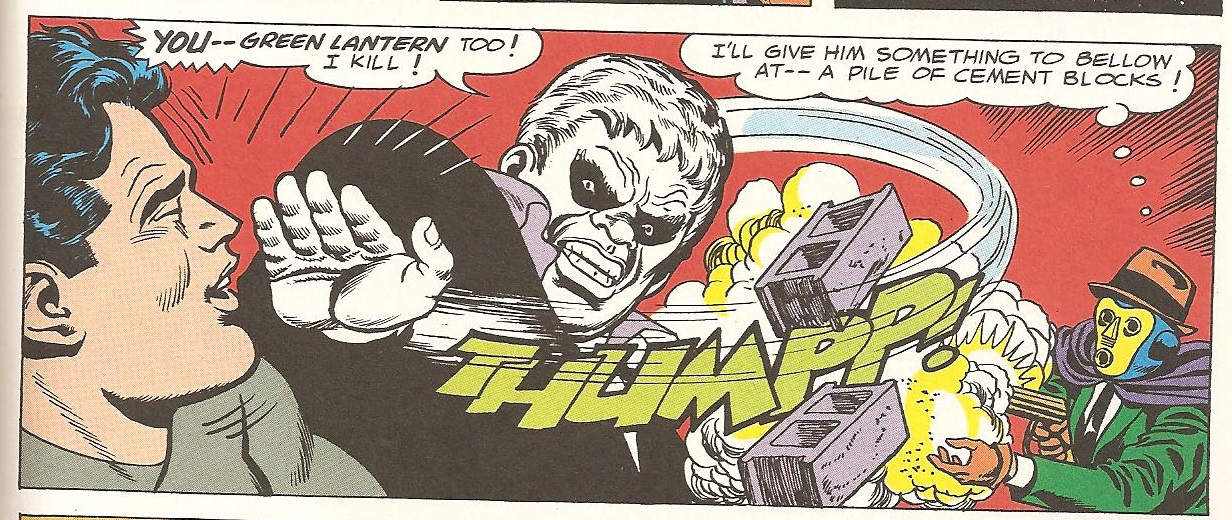
 Remember how Dodds would leave specks of sand as his calling card? Now, he actually goes around spraying sand at people (or just throwing it), with nary a mention of his sleeping gas! But that in itself is not as crazy as what he does once the sand hits the air:
 Yes, he carries around a flame-thrower so hot, that the heat turns the sand he throws (in mid-air) into glass.
  He can even create entire barriers and create cement blocks out of it:
 Morpheus of The Endless and Flint Marko will always be the most well-known Sandmen in comics, but it’s safe to say none of them have ever done anything quite as crazy as this.

Thursday, November 22, 2012

A Hawkman Thanksgiving

 Well, hopefully everyone’s Thanksgiving dinner went well. Hopefully the turkey didn’t burn, hopefully Uncle Manny didn’t drink all the wine, hopefully your horny idiot nephew didn’t decide to re-enact Mantan Moreland’s legendary mashed potatoes routine, and hopefully your gracious host didn’t decide to use his death ray to blackmail the government after trying to bribe you not to foil his schemes.
 I know I’ve been posting bad comics to fit with this month’s “turkey” theme, but this Hawkman adventure is pretty good. There are some silly things, such as the design of the villain, who should look like a modernized Greek emperor to keep with the “Alexander” theme, or at least be handsome (Alexander the Great was one of the few historical figures who actually was handsome, by all accounts), but nooo. Still, I thought the formal dinner party atmosphere and having a hero named after a bird would fit.
 From Flash Comics #2, here’s “The Globe Conqueror” by Gardner Fox and Dennis Neville. Enjoy! All © DC.

~


Monday, November 14, 2011

The First Appearance of The Gentleman Ghost:

 Hey, I had the scans in my computer, so why not? Guess I'm on a Hawk-roll. Here's "The Ghost" from Secret Origins #1, as originally presented in Flash Comics #88. It's not a great story by any means, and that has to be the worst Joe Kubert art I've ever seen (although the fog-enshrouded visualization of the Tower of London is quite striking), but even the worst Kubert art is better than the best of 80% of the schmoes working today!


 I like how they play around with whether or not the Ghost is really supernatural or not, that's just what any good ghost story needs. You can see why The Ghost would be Hawkman's arch-foe for the rest of the 40s (in fact, his only recurring villain). 'Ol Gentleman Jim wouldn't be revived until 1969 (where he was made into a more three-dimensional character as well), but during the earlier Silver Age there were what I consider slight homages to him:

  Coincidences? Anyway, enjoy. All  © DC comics.


Carter better hope and pray that any angry gangsters with good aim don't have a fetish for acid...


  I love that ending. I wonder how altered it was for the blurb for Wanted? Still, it sticks out. Can you prove that it didn't happen? Remember my friends, future events such as these will effect you in the future.

Saturday, November 12, 2011

The Golden Age Hawkman Archives Vol. Review:


Collecting Flash Comics #’s 1-22.
 It’s interesting how when one looks back at the adventures of Golden Age heroes they all embody different archetypes: Superman is a messiah figure, coming from the heavens and seeking out truth as a reporter, while fighting social ills as Superman. Batman is a mystery man whose modus operandi is similar to a “masked mystery villain” from an old dark house thriller (in fact, he was inspired by a villain in just such a film). The Green Lantern is like Aladdin, a poor boy given great magical powers to change his lot in life. The Spectre is an avenging wraith. Sub Mariner is a “noble savage”. Plastic Man and Flash are trickster figures. I think you get the picture. Still these were all idealized archetypes that we can still look up to today, free of guilt.
 However, there was one golden age hero who embodied an archetype that in today’s politically correct-world, readers would find uncomfortable seeing presented in the role of hero, and who sadly, was a far more realistic example of what a wealthy adventurer during this time period would have been like: The old school imperialist, the great white hunter/scientist/adventurer. The type of character who would have no problem attacking foreigners or non-white people just because he didn’t like their looks, would go berserk at anyone who dared to challenge his wealth and power, would cause massive destruction to civilians that he would chalk up as collateral damage, treat women like dirt, and just in general do everything more for kicks than out of any genuine altruism. You could imagine this guy as the protagonist in a story by Sax Rohmer or Rudyard Kipling.
 Ladies and gentlemen, I give you Carter Hall; the original Hawkman! Carter could be just as bland and stolid as any other hero of the era, but a lot of the time he was arrogant, sadistic, racist, sexist, and just an all-around privileged jerk.
 Yet, I have not come to bury Hawkman, but to honor him. I’m not trying to blow a PC trumpet either (actually, any readers of this blog should know I’m anything but PC), rather I’m trying to point out how Hawkman embodied more than just the “winged hero” archetype, but the “privileged adventurer” archetype as well. Many golden age comics get criticized for how racist, or jingoistic their heroes’ attitudes seem, but for the most part, these “mistakes” seem to be just that; honest slip-ups, or attempts at being progressive that read as patronizing (ie. Any minority sidekicks, like Chop-Chop or Ebony). Hawkman however, showed signs of this behavior throughout nearly all of his adventures. The incredible thing was that Gardner Fox (who wrote almost all of the original Hawkman stories) seemed to intend this unpleasant characterization. He was probably just copying the various adventure fiction of the time, but at least it gave Hawkman a distinct personality among a sea of dull, one dimensional heroes.
 And it’s exactly that snobbish and brutal attitude of faux-elegance that helps these stories stand out so well. Oh, there are still plenty of obvious influences from other comics and pop-culture of the time; many of these stories read exactly like pre-Robin Batman stories (in fact, had Bill Finger never gotten involved and created “Batman”, I’m sure Gardner Fox and Sheldon Moldoff would have turned Bob Kane’s “Birdman” character into something quite like Hawkman), and Hawkman himself inarguably owes a visual debt to the Hawkmen from the Flash Gordon newspaper strip (in fact, Sheldon Moldoff, the artist for most of these stories, swipes panel poses and layouts from Flash Gordon quite a bit) but it all boils down to one of the easiest to get through of the Golden Age DC Archives. It’s utterly fascinating, both in the brutality of the stories and the obnoxiousness of the hero.
 The origin story is easily one of the best conceived of the entire era. Carter Hall is a filthy rich weapons collector who has a blackout upon receiving an ancient Egyptian knife. In the flashback, Hall finds he was once a prince named Khufu who sought to protect his love, Princess Shiera, from the evil sorcerer Hath-Set (who, naturally, being a villain and all, is the only character in this flashback who looks like a real Arab), only for both of them to be killed (by naturally, the knife that Hall received in modern times). With his dying words, Khufu cursed all three to be reincarnated, to see who the victor would be in another lifetime. Carter reawakens, and ends up meeting both Shiera (who is a society woman) and Hath-Set, who is now a mad scientist named Hastor. Carter uses a set of wings made of “ninth metal” and a hawk-costume, and adopts the identity of The Hawkman, and sets out to stop Hastor’s mad schemes. Subsequently, he goes onto fight crime, with Shiera at his side occasionally, fighting “evils of the present with the weapons of the past”.
 This first story loses quite a bit of credibility at times, such as when Carter just pulls out a Hawk costume with metal wings that allow him to fly, with no prior indication in the story that he was an inventor (just a “researcher’), as well as Gardner Fox’s hilarious misunderstanding of Egyptian mythology. Nevertheless, it’s quite an ambitious little story, combining doomed romance, reincarnation, revenge, and still having time for a showdown with a super-villain. Along with the origin of The Flash, kids who purchased that first issue of Flash Comics sure as hell got their money’s worth.
 There are lots of interesting little tidbits too, such as that in the flashback; we see that Khufu was perfectly willing to kill Shiera himself so that they could die together! Holy crap! And people complain about unhealthy relationships in comics now! I don’t know of any modern superhero origins that have resulted from what was almost a suicide pact. I also think it would have been far more fitting if the showdown between Hastor and Hawkman had involved the same knife that the story begins with. Oh well.
 The art by Dennis Neville (who draws the first three stories) is quite good, if more than a little sketchy. It has a Hal Foster-ish feel that’s perfectly appropriate. Neville isn’t always the most visually inventive of artists (the second story involves a mad scientist who has both named and patterned himself after Alexander the Great, but rather than drawing him to look like Alexander, or at least, like a Greek, Neville depicts him as a man with a huge, bald, almost phallic-shaped head, to indicate that he’s smart) but it’s still sad to see him go. The art is then taken over by Sheldon Moldoff, who despite his infamous habit of copying others, nevertheless brings a real sense of majesty to the stories, and he tries to give the reader the feeling that they are really there when Hawkman goes to visit an unusual locale. Moldoff can make a fairly mundane story about, say, a search for treasure in Colorado (where the villain’s name is John Denver!) more fun than it has any right to be.
 All in all, these stories offer quite a bit of variety, from battles with super villains, to adventures in lost lands or foreign locales, murder mysteries, typical mundane cops and robbers’ melodrama, and even the occasional horror story.
 And through it all, Carter Hall is a huge jackass, which, as I’ve said before, is what makes these stories so entertaining, although at times you really want to see the villains (or Shiera) kick his ass. My guess is he never quite got over being a prince in his past life. From what I’ve seen, this would continue throughout the Golden Age run. Some of the funnier bits of asshole-ery from Carter Hall include:
 - Flash Comics #5: Carter follows a middle-eastern man around just because he’s “one of the same sort” (aka ethnic type) as a would-be assassin that he read about in the paper. Only by sheer luck (aka plot convenience) is he right about the guy being involved. But that’s not all, he also spends this story, and the next (this is a two-parter) assisting (and flirting with) a female government agent named Ione Craig. Several issues earlier, in issue #2, it was made clear that he had become engaged to Shiera.
- Flash Comics #9: Hawkman investigates a bunch of hairy, amphibious brutes from under the sea called Kogats, which have been kidnapping surface dwellers. The visual of Hawkman swimming underwater with a diving helmet on is hilarious. He also meets up with the god Poseidon, who gives him the power to breathe underwater (!!!??). In order to permanently destroy the Kogats, Hawkman causes an undersea avalanche, and then he reckons that “plenty of boats sunk tonight as the ocean heaved, but better a few ships than the entire world”.  
-Flash Comics #10: Carter gets outbid for a Spanish blunderbuss at an auction. He considers this incentive enough to follow the guy who outbid him and break into his home as Hawkman. Yes, just because the guy outbid him. Thank god E-bay didn’t exist back then, or every bidder would have found themselves on the receiving end of Hawkman’s mace.
-Flash Comics #16: Shiera is on an archeological expedition, and they are soon set upon by a hidden tribe and slaughtered until only Shiera remains. Carter, as Hawkman, flies over to rescue her, but because his sword resembles one from their mythology, the tribe members honor him like a god, and he helps them defeat an invader. Nowhere in the story does he so much as reprimand them for, you know, slaughtering an entire expedition and traumatizing his fiancée. Treat Hawkman like a king, and you’re alright with him.
-Flash Comics #19: Carter makes Shiera a bet about the identity of a villain; if he wins she’ll have to take him out to dinner at the most expensive joint in town (which you know, he should be able to afford easily without asking her). He already knew the villain’s identity in advance. “This ought to teach you a lesson…and to stay out of my affairs” he says, after the dinner. What a dick. To be fair, it’s revealed in the last panel that he sends her a check. Awww, he really does love her…..then in the next story he mitigates it all by calling her a “meddling little idiot”, calls her that again in another story, and then contemplates letting her be injured as punishment for trying to best him at being a detective.
 So what we have here is a hero who cheats on, scrounges off of and verbally abuses his fiancée, makes judgements about people based off of their race, goes after people because they outbid him at auctions, forgives murdering savages if they all bow down to him, and causes collateral damage that exceeds what the villains were doing, even though he had a freakin’ god on his side. He also builds up a body count that rivals that of the Spectre, both for volume and sadism, like snapping people’s necks with bolas, or stabbing their necks with tridents, arrows, swords and…hey this man has a predilection for necks, doesn’t he? Even funnier, later on in the volume, Sheldon Moldoff includes a feature at the end of the story where he describes the weapons that were shown in the story in detail, in postage stamp size so the kids could cut them out.
 Oh, is it legal to have this much fun when reading about such a douchey character?
 Also, while on the subject of the violence, it’s kind of a shame that so many of the villains die, because Gardner Fox consistently thinks up some fairly interesting adversaries for Hawkman. Dr. Hastor/Hath-Set certainly has potential, as Geoff Johns later realized. In fact, the end of the story implies that Hastor would return someday (despite very clearly dying), but up until the 2000s, that never happened. Alexander the Great, from the second story, had some good archenemy potential as well, since he grudgingly seems to respect Hawkman and invites him and Shiera over for a James Bond-style dinner. Alexander’s scheme; to increase the gravitational mass of objects, such as say, the upper floors of buildings, in order to crumble them, is actually a fairly intriguing and somewhat plausible sci-fi concept. The Thought Terror, from a story which I’ve covered before, is both a powerful and visually interesting foe, with his robes and hypnosis gimmick.
 Other cool villains include Czar (a golem-like creature that achieves a Frankenstein-like pathos, and who sadly comes to one of the most brutal and merciless ends in the whole volume), a cult that worships a crocodile god, Satana; a female brain surgeon who transplants human brains into tigers (ironically, my copy of this book contains a printing error where the pages of this story are out of order), and The Hood, a mad scientist who invents a “cold light” and whose real name is Pratt Palmer! Someone at DC should bring the Hood back just so they can reveal him to be related to one of the Atoms; Al Pratt or Ray Palmer.
 Also, Shiera, oh, we need to talk about Shiera. In the first story she’s little more than a damsel in distress, but that’s okay because she is understandably confused and upset about what’s happening. Then in the second story she and Carter get on quite well, like a more bloodthirsty version of Nick & Nora Charles from The Thin Man. In the “Thought Terror” story she gets to help save the day and is shown to be quite competent without Hawkman’s help. After that her characterization is inconsistent. In that and other stories she’s a really well-written and courageous woman who only needs help from Hawkman because she’s facing some sort of fantastic menace that no ordinary person, male or female, could defeat. It’s almost revolutionary, though not quite as good as Dian Belmont’s characterization in the Sandman series. In fact, in some later Golden Age stories I’ve read, like the story which introduced Hawkman’s archenemy The Gentleman Ghost (known then simply as “The Ghost”), it was Shiera who often had to coerce Carter into action:
 Then in other stories, Shiera really does seem to be a “meddling little idiot”, and all props I can give Fox for his characterization of her goes out the window. In one of the stories, she doesn’t even seem to know that Carter is Hawkman even though she’s known since the first story! What the-! Even worse, in some stories, she is characterized as an intelligent and competent heroine, but Carter holds it against her and yells at her for it, even though she’s helped him on many dangerous cases. I’m no feminist, but jeez, no wonder modern writers have tried to play up Shiera more than Hawkman himself. At least Gardner Fox was progressive enough to later let her become Hawkgirl and join in on the action. It’s horribly inconsistent, but still, for attempting to make the love interest more than a typical Lois Lane-type, and occasionally giving her some good moments, these Hawkman stories deserve extra praise.
 So with its beautiful artwork, interesting story ideas, occasionally progressive moments for its heroine, high-level of violence, and at times thoroughly nasty lead character, this is a volume that stands out. For all of their cribbing from other sources, you likely won’t ever read any Golden Age stories quite like these. 4.5/5. Recommended.